Tower Dash is the newest game on the InOut shelf as we write this at the end of September 2026, and its whole idea fits on a hook: a crane swings a building block over a construction site, you press the button to let go, and every block that lands squarely lifts your multiplier one rung. Cash out whenever you like; watch one block slide off the edge and the round is over. It is the studio’s second go at the stacking formula after MegaBlock, and it arrives with a 96% RTP, three difficulty levels and two Bonus Buys that play nothing like each other. We spent an evening on the demo, bought the pricier bonus with a $1,000 ticket and taped every one of its eleven towers.
 United States
Tower Dash available at Cafe Casino
United States
Tower Dash available at Cafe Casino
Free browser play - no download, no registration, no deposit
Same game, real wins
Cafe Casino runs the same Tower Dash with the same odds and adds a welcome bonus for players from the United States:
300% up to $2,000 + 150 FS 18+ · T&Cs apply · the demo stays freeOne crane, one button, one decision per block
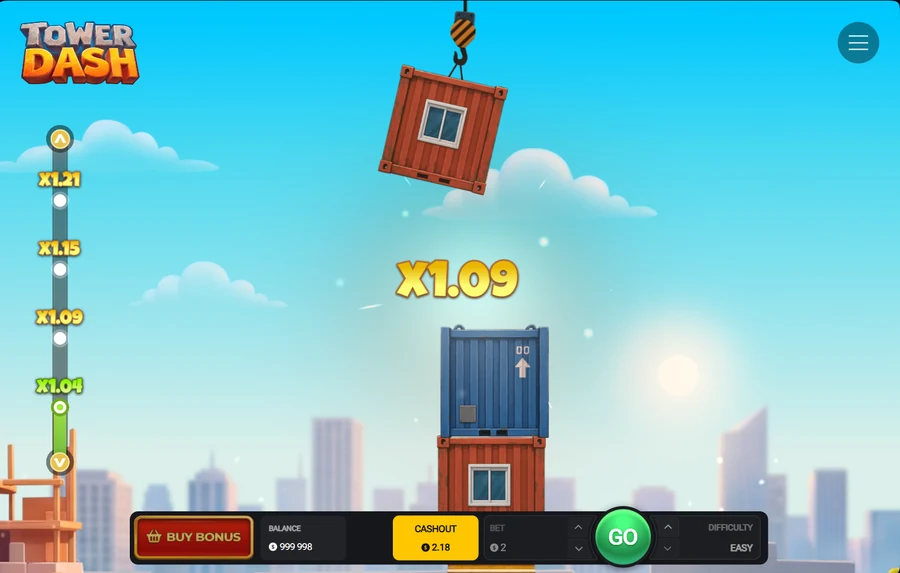
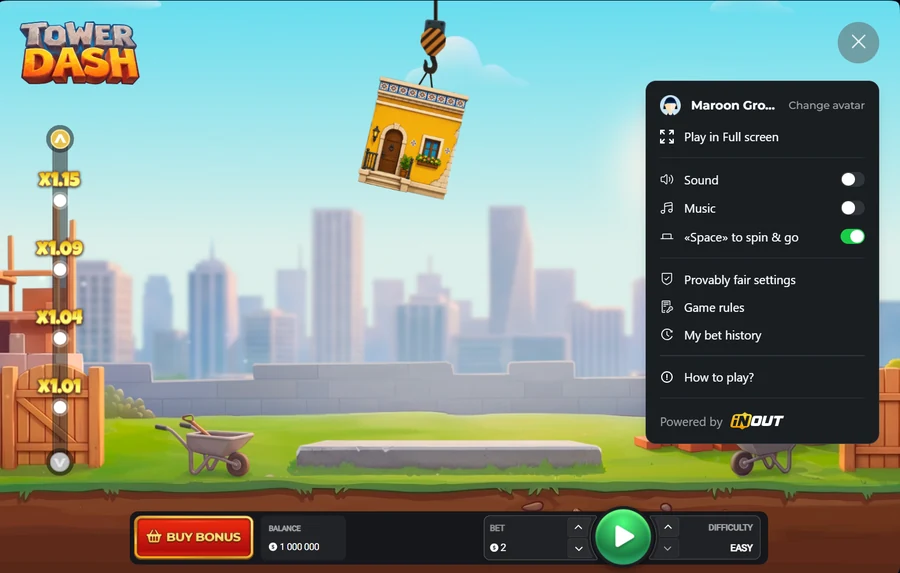
A round is short enough to explain in a breath. Set a bet in the panel at the bottom (the demo opens at $2 on a $1,000,000 balance), pick a difficulty with the arrows on the right, press Play. A block appears on the crane hook and starts swinging across the top of the screen; the Play button turns into GO, and pressing it drops the block. Land it on the concrete slab, or on the tower you have already built, and three things happen at once: a multiplier pops up in the middle of the screen, the ladder on the left lights that rung green, and a yellow CASHOUT button shows exactly what your bet is worth right now. Press GO for another block or CASHOUT to bank. A block that misses the tower ends the round and takes the stake with it.
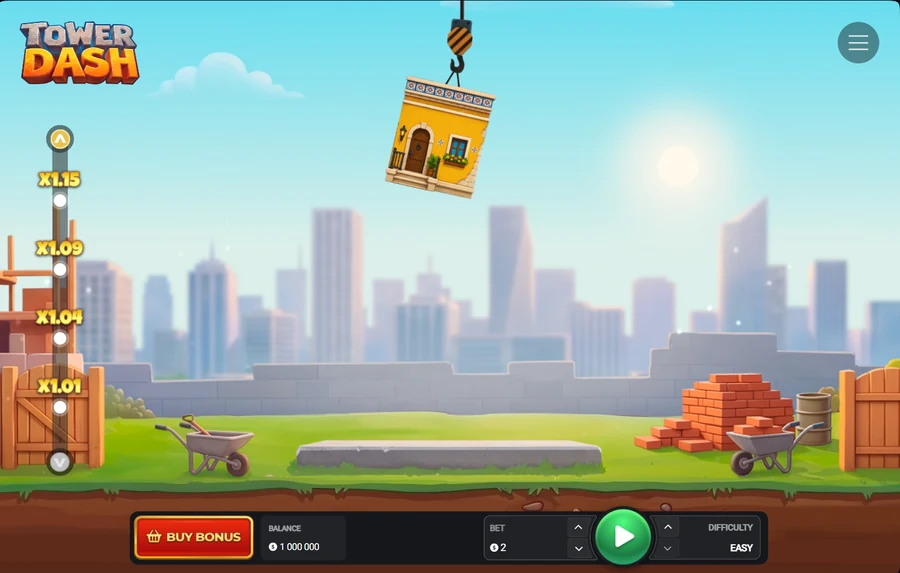
The blocks themselves are pure set dressing. One round stacks yellow Mediterranean townhouses with flower boxes, the next a stone keep with torches by the door, then a log cabin, then red and blue shipping containers, then an ornate blue facade. Each tower is built from one style, and the camera follows the top floor upward, so after the third or fourth block the base scrolls out of view behind the control bar. None of it changes the maths: the multiplier does not care whether you are stacking castles or cargo.
Three difficulties, three ceilings
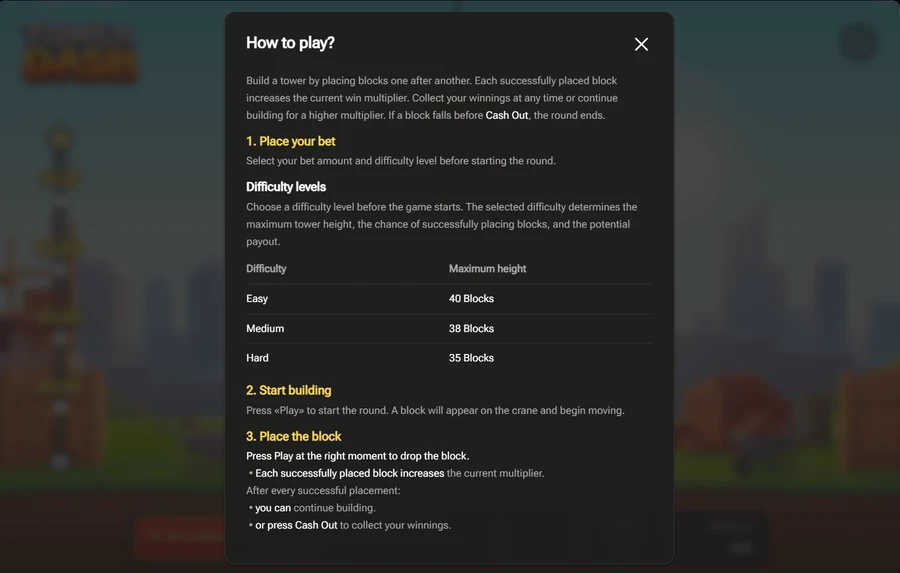
The in-game How to play screen is short and unusually precise. The difficulty you pick before the round “determines the maximum tower height, the chance of successfully placing blocks, and the potential payout”, and a small table gives the heights. We have added the opening rungs we recorded on each ladder.
| Difficulty | Max height | First rungs we saw | Character |
|---|---|---|---|
| Easy | 40 blocks | 1.01 - 1.04 - 1.09 - 1.15 - 1.21 | Flattest ladder, tallest tower |
| Medium | 38 blocks | 1.02 - 1.09 - 1.18 - 1.29 - 1.42 | Both bonus games run here |
| Hard | 35 blocks | Not recorded in our session | Shortest tower, steepest climb |
Read the middle clause of that rule again: the chance of placing a block. On screen the drop looks like a timing test, the block swinging left and right while you wait for the right moment, but the rulebook frames success as a probability set by the difficulty, and the bonus rounds, which build automatically with no input from you at all, produce the same mix of collapsed and completed towers. Treat the swing as presentation and the difficulty selector as your real risk control, the same way the published odds do the work in Penalty Nations Cup.
The ladders back that reading up. Easy opens 1.01, 1.04, 1.09, 1.15, 1.21 and the rungs around our exit read 1.36, 1.45, 1.55 and 1.66 - a long, gentle slope. Medium opens 1.02, 1.09, 1.18, 1.29, 1.42, 1.58 and then stretches: 2x, 2.29x, 3.6x, 5.11x, 7.52x, 9.27x, 11.53x, 18.38x, 23.56x and 52.85x are all rungs we watched light up during the bonus. The gap between rungs widens as the tower grows, so the top of a 38-floor Medium tower is worth far more than its first ten floors put together. What a completed 40-block Easy tower or a 35-block Hard tower actually pays, InOut does not print anywhere, and we never got high enough to read it off the rail.
A $2 round on Easy, block by block
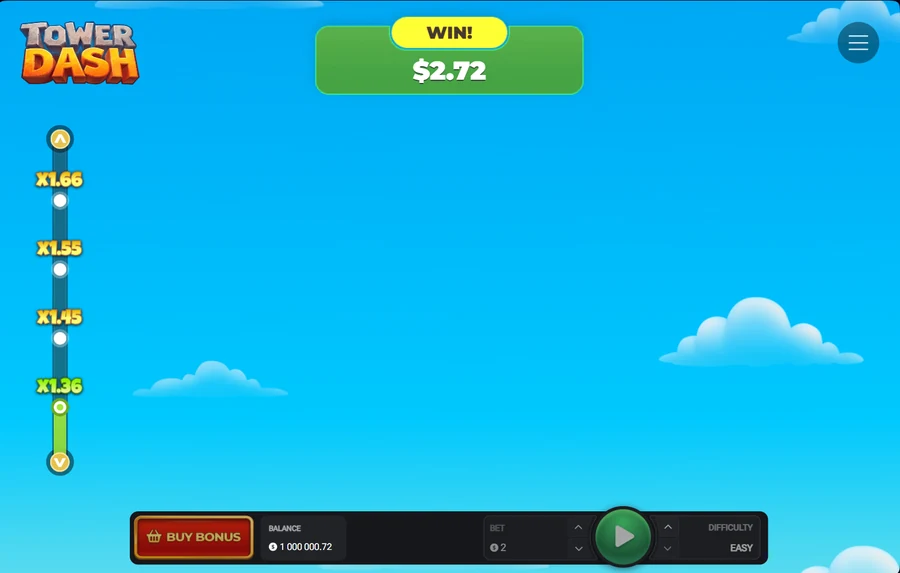
Our first proper round was a $2 stake on Easy. Two shipping containers were already stacked and a third was swinging on the hook when the multiplier reached 1.09x - the third rung - and the CASHOUT button read $2.18. That number is the full return, not the profit: 2 x 1.09 = 2.18, and the balance behind it had already dropped to $999,998 when the stake was taken. Every rung after this is a fresh version of the same question, keep building or bank.
We kept pressing GO until the ladder showed 1.36x, then cashed out. The green WIN banner read $2.72, and the balance settled at $1,000,000.72: the $2 stake back plus 72 cents, which is exactly 2 x 1.36. A round on Easy is a slow burn by design. Nothing in its first ten rungs will change your evening, and that is the trade the level offers: the flattest ladder in exchange for the tallest tower, forty floors if you can get there.
The buy menu: a hard hat or a whole skyline
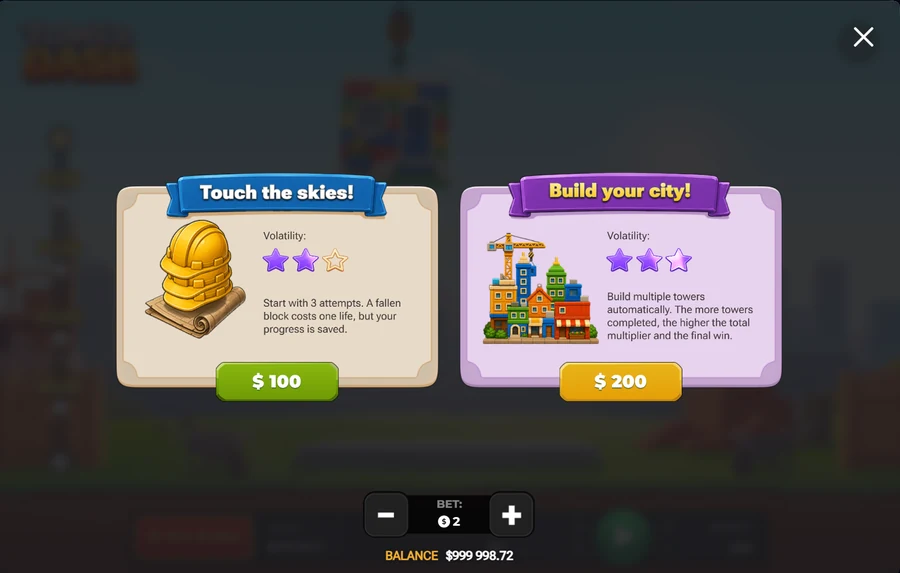
The red BUY BONUS button opens two cards with a bet stepper underneath them, and the prices scale with the bet you set on this screen, not the one on the main panel. Touch the Skies costs 50x the bet and carries two of three volatility stars; Build Your City costs 100x and fills all three. At our $2 bet the cards read $100 and $200. We stepped the bet up to $10 and watched the same two cards turn into $500 and $1,000.
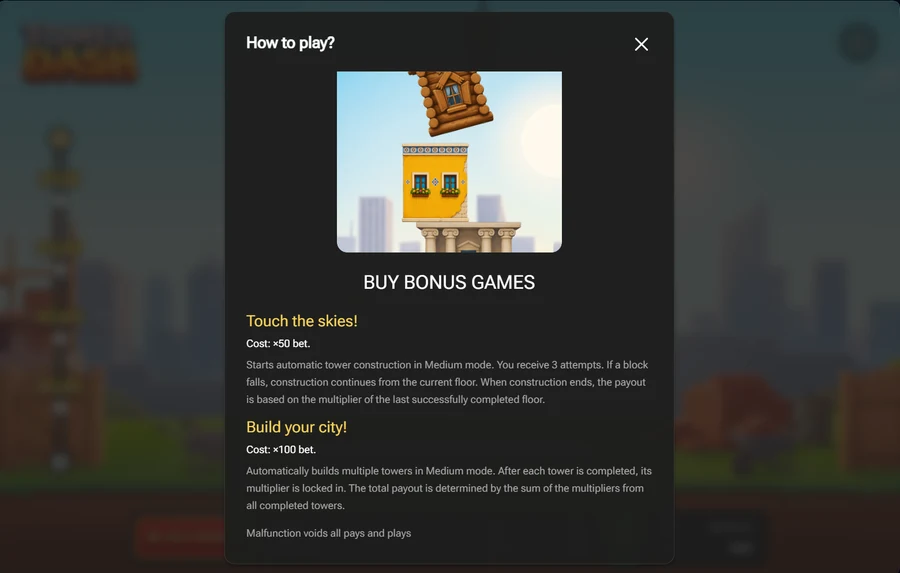
The rulebook spells out what each ticket buys. Touch the Skies starts automatic construction of a single tower in Medium mode with three attempts: a fallen block costs one life, but the tower is not reset - building carries on from the current floor, and when the attempts run out the payout is the multiplier of the last floor completed. Build Your City starts automatic construction of several towers, again in Medium; each finished tower’s multiplier is locked in, and the payout is the sum of every locked multiplier. Two details worth underlining: both bonuses run in Medium regardless of the difficulty on your main screen (ours said Easy, the bonus bar said MEDIUM), and the screen closes with the studio’s standard line that a malfunction voids all pays and plays.
Tower Dash bonus video: Build Your City for $1,000
Rules do not tell you what eleven automatic towers feel like, so we bought the full-price ticket and let the tape run. Bet $10, price $1,000, balance from $1,000,377.82 to $999,377.82, and a splash screen with the shutters thrown open: BUILD YOUR CITY! FREE SPINS 11. The sky turns to sunset for the bonus, a hot-air balloon drifts past the taller towers, and the rail on the left does something the base game never does - it stacks up the locked multipliers of every finished tower under the one currently being built. Watch the Round counter in the corner and the moment tower five starts running away.
Here is the round tower by tower, read straight off the rail, with what each tower was worth at a $10 bet.
| Tower | Locked multiplier | Worth at $10 |
|---|---|---|
| Tower 1 | 1.09x | $10.90 |
| Tower 2 | 1.29x | $12.90 |
| Tower 3 | 7.52x | $75.20 |
| Tower 4 | 1.29x | $12.90 |
| Tower 5 | 23.56x | $235.60 |
| Tower 6 | 1.58x | $15.80 |
| Tower 7 | 1.42x | $14.20 |
| Tower 8 | 2.29x | $22.90 |
| Tower 9 | 11.53x | $115.30 |
| Tower 10 | 2.29x | $22.90 |
| Tower 11 | 52.85x | $528.50 |
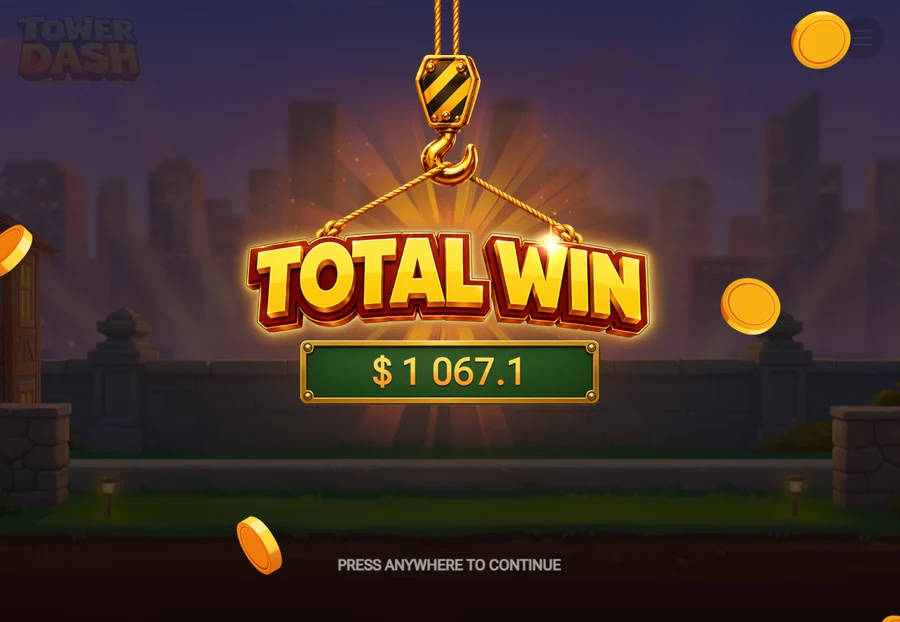
Add them up and you get 106.71x, and the game does the same sum in front of you: the closing animation flies each locked value into a running counter, flashes “$10 x 106.71”, and the tally screen hangs a TOTAL WIN of $1,067.10 from the crane. Against a $1,000 ticket that is a $67.10 profit, 6.7% on the money. Now look at how it was made. Seven of the eleven towers fell before 2.3x and together contributed 11.25x; the four that got going - 7.52x, 11.53x, 23.56x and 52.85x - contributed 95.46x, almost nine tenths of the payout. That is what three volatility stars mean in practice: an eleven-tower bonus is really a bet on two or three towers catching fire, and this one only finished in profit because the very last tower climbed to 52.85x. Had tower eleven folded at 2.29x like the one before it, the total is 56.15x, $561.50, and the ticket loses $438.50.
RTP, and where the 96% comes from
The official Tower Dash page is thinner than InOut’s usual: a two-paragraph description, “Single Player”, and the names of the two bonuses. The RTP and Release Day fields the studio prints for most games are simply absent. The 96% on this page comes from the game itself - the client that loads in the demo frame carries an RTP setting of 0.96 in its configuration. We checked the same setting on Cricket Road, where it reads 0.955 against a published 95.5%, so it is a per-game value and not a placeholder. The build we played is dated 28 August 2026 and the catalogue still flags the game as new at the end of September; a release day has not been announced. Nothing has been published on the maximum win, the bet limits or the volatility beyond the stars on the two bonus cards, and we will not invent any of it.
| Provider | InOut Games |
|---|---|
| Game type | Crane-and-blocks crash game, step ladder |
| RTP | 96% (game client configuration) |
| Difficulty | Easy 40, Medium 38, Hard 35 blocks |
| Cash out | Any time after a placed block |
| Bonus Buy | Touch the Skies 50x - Build Your City 100x |
| Bonus mode | Always Medium, built automatically |
| Volatility | 2 of 3 and 3 of 3 stars on the bonus cards only |
| Fairness | Provably fair settings in the menu |
| Platforms | HTML5 - desktop, iOS, Android |
| Released | Late summer 2026, no official day published |
The menu, the spacebar and provably fair
The round button in the top-right corner opens the standard InOut panel: an avatar you can change, Play in Full screen, Sound and Music toggles (both off by default in the demo), a “Space to spin & go” switch that maps the spacebar to the drop button, Provably fair settings, Game rules, My bet history and the How to play screen quoted above. The spacebar option matters more here than in most of the studio’s games, because the drop is the whole interaction; on a desktop you can play an entire round without touching the mouse. The bet history is the place to check your own tower-by-tower arithmetic after a bonus.
Where it sits next to InOut’s road games
Mechanically Tower Dash is a step ladder stood on its end. Chicken Road counts lanes, Cricket Road counts deliveries, Rabbit Road counts hops; this counts floors, and it counts more of them - 40, 38 and 35 blocks against the roads’ 30, 25, 22 and 18 steps - which is why its opening rungs are so much flatter than a Hardcore road. Against its stacking sibling the differences are sharper. MegaBlock runs four risk levels, seasons the tower with special floors and publishes a maximum win; Tower Dash runs three levels, keeps every floor plain, publishes no ceiling, and instead spends its design budget on the two bonus tickets. The Build Your City idea of locking each tower and summing the lot is closest to the free games in Chicken Road 2 Bonus, where the multiplier also refuses to reset, and the only vertical climb in the catalogue with genuine hand-eye skill in it remains Frog Jump. If you liked Royal Drop for turning a phone puzzle into a payout, this is the same trick played on the tower-stacking genre.
Free demo
The demo above runs on virtual credits - a $1,000,000 balance, a $2 default bet, no account - and it is the full game: all three difficulties, the bet stepper inside the buy menu and both bonus tickets. Our $1,000 Build Your City purchase was demo money, and that is the sensible way to price a 100x ticket before you ever stake real currency on it. Ten bought bonuses in the demo will tell you more about the game’s temperament than any rulebook, ours included.
Tower Dash APK and download
There is no Tower Dash APK, and nothing on this page needs one. The game is HTML5 and loads straight in the browser on Android, iPhone and desktop - the same crane, the same ladder, the same buy menu, with no install, no sideloaded package and no storage used. Tap the demo above on a phone and it opens in portrait with the control bar along the bottom.
- Instant play in any mobile browser
- Works on Android, iOS and desktop
- No install and no phone storage used
- Always the latest, up-to-date version
The advice is the same as for every new InOut release: launch weeks are when unofficial ‘Tower Dash app’ downloads start circulating, and none of them come from the studio. The browser build is always the current one. For one-tap access, open the game and use ‘Add to Home Screen’ - an icon on your phone, none of the risk.
Tower Dash FAQ
What kind of game is Tower Dash?
What is the RTP of Tower Dash?
How do the three difficulty levels differ?
What do Touch the Skies and Build Your City cost?
Is buying Build Your City worth it?
Can I play Tower Dash for free?
Is there a Tower Dash APK or download?
The verdict
Tower Dash is a tidy, honest piece of design that knows exactly what it is. The base game is a ladder you can read at a glance, with three levels that genuinely change the shape of a session rather than just the speed of the losses, and the buy menu is the most interesting the studio has shipped since Royal Drop: one ticket that forgives two mistakes, one that turns the game into a portfolio of towers and adds them up. We would like the missing numbers - a release day, a published RTP, a maximum win - to appear on the studio page, and Easy can feel like watching paint dry for the first dozen floors. But the arithmetic checks out to the cent on every screen we recorded, the 96% is above the catalogue’s middle, and a bonus that ends on a 52.85x tower after seven collapses is the kind of story a crash game should be able to tell. Learn the Medium ladder in the demo first; it is the one both bonuses are built on.