
Pulsar came out on 27 October 2026 and nothing else in the InOut catalogue plays like it. A green line, the Pulsar, zigzags from left to right across a grid of numbered cells, and you bet that it will pass through one of them. Cells next to the line pay under 2x, cells four rows away pay fifty times the stake or more, and the number is fixed the moment the bet is accepted. InOut lists the RTP at 94%. We put eighteen 50-cent bets through the studio’s build, free in the browser and asking for no registration, hit seven and finished $3.02 ahead, most of it from one cell two rows under the line that paid 8.72x.
 United States
Pulsar available at Cafe Casino
Free browser play - no download, no registration, no deposit
Same game, real wins
Cafe Casino runs the same Pulsar with the same odds and adds a welcome bonus for players from the United States:
300% up to $2,000 + 150 FS 18+ · T&Cs apply · the demo stays free
A line that never stops and a grid that keeps scrolling
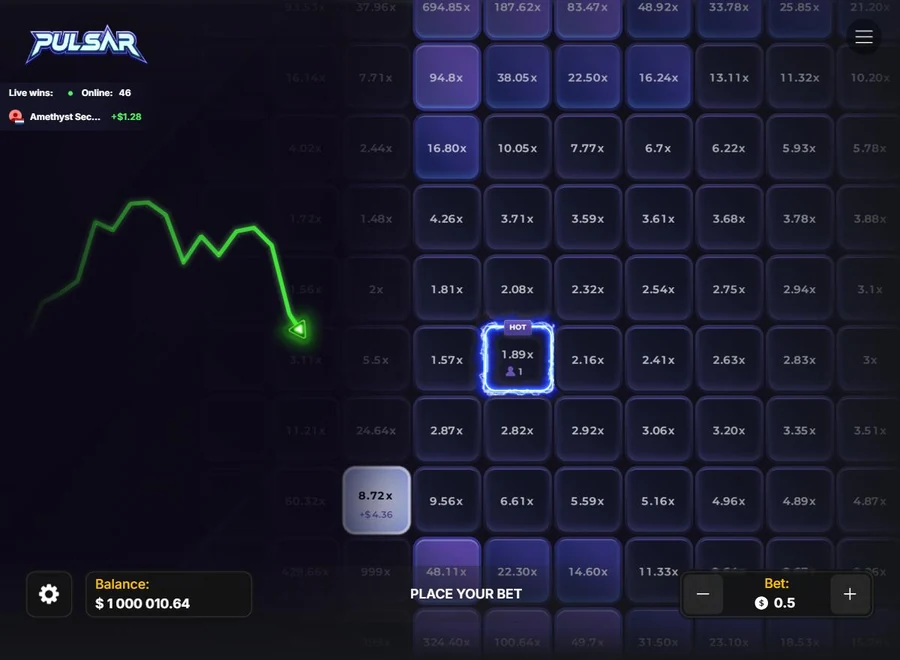
The field moves all the time. New columns slide in from the right, finished ones leave on the left, and the line keeps drawing itself in short jagged strokes, up two rows, down one, flat for a moment. The two columns directly in front of its tip are dimmed and cannot be bet on; from the third column onward every cell is open until the line gets close. Three intro cards spell out the whole game: choose a cell, the coefficient locks, and if the Pulsar crosses the cell the bet wins.
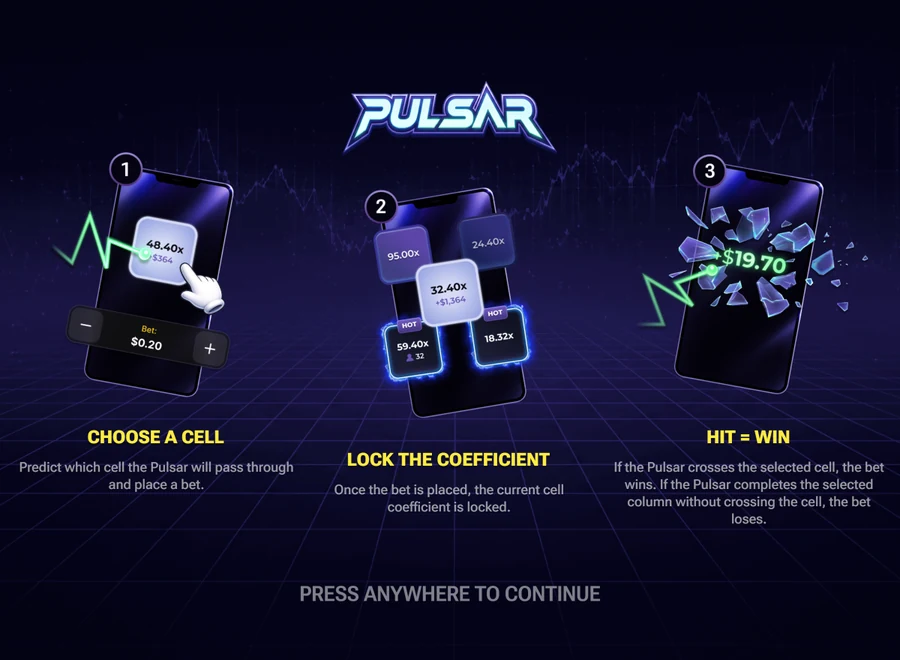
There is no cash-out button and nothing to press once the chip is down. The rulebook gives the loss condition in one line: the Pulsar completes the selected column without crossing the cell. That makes Pulsar the opposite of a timing game like BalloniX, where the whole decision is when to jump; here the only decision is where to stand, and the result arrives two or three seconds later whatever you do.
How the cells are priced
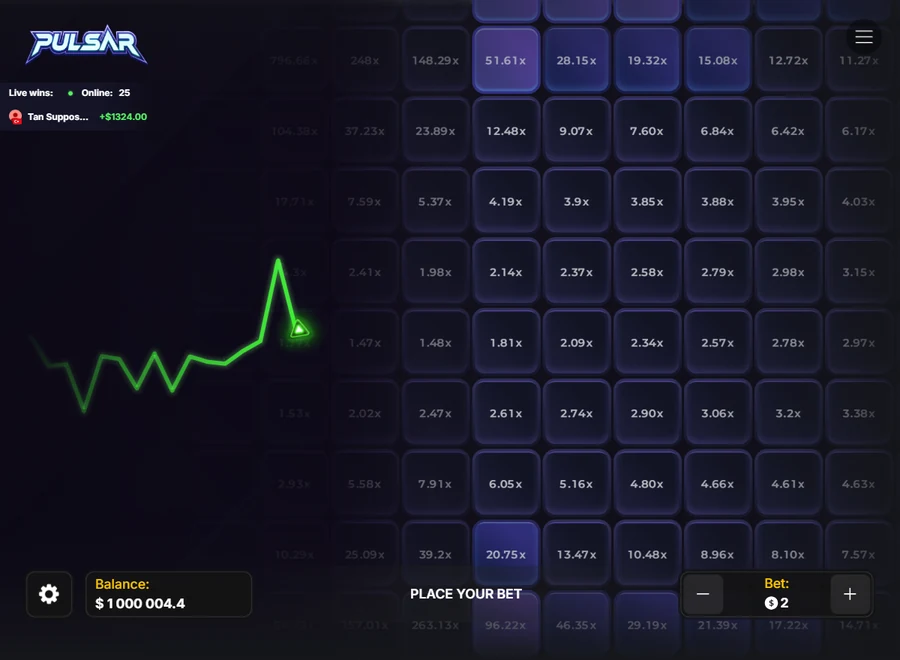
One frame of the board, taken a few seconds after the game loaded, shows the pattern that held all session. The table reads the first open column, the next one, and the column five steps further right, row by row from the top.
| Row | First open column | Next column | Five columns later |
|---|---|---|---|
| 4 rows above | 51.61x | 28.15x | 11.27x |
| 3 rows above | 12.48x | 9.07x | 6.17x |
| 2 rows above | 4.19x | 3.9x | 4.03x |
| 1 row above | 2.14x | 2.37x | 3.15x |
| The line’s row | 1.81x | 2.09x | 2.97x |
| 1 row below | 2.61x | 2.74x | 3.38x |
| 2 rows below | 6.05x | 5.16x | 4.63x |
| 3 rows below | 20.75x | 13.47x | 7.57x |
Two things move in opposite directions. Close to the line, a cell further to the right pays more, because the line has more time to wander off: its own row climbs from 1.81x to 2.97x across six columns. Far from the line it is the reverse, because more time means more chance to get there: four rows above, the price falls from 51.61x to 11.27x. Two rows away the two effects cancel and the cells sit near 4x all the way along. The sides were not mirror images either. One row above opened at 2.14x and one row below at 2.61x a moment after the line had spiked upward, so the pricing appears to follow the line’s recent path; InOut does not publish how it is calculated.
At the edges of the screen the numbers stop growing. Cells in the top and bottom corners read 999x or 999.00x, which looks like the per-cell ceiling: we saw nothing higher in any frame.
Eighteen bets at 50 cents
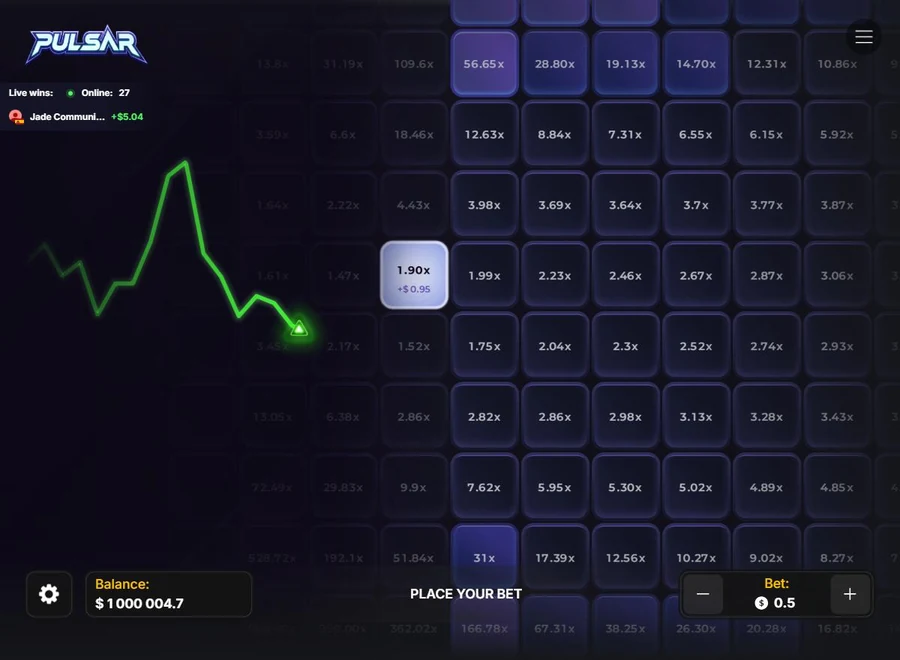
The bet panel opens at $2. Four presses of the minus button brought it to $0.50, where it stayed for the whole session; the bottom stop is $0.12, eight presses down. The first bet went on a 1.90x cell one row above the line. Once accepted, the cell turns pale and shows two lines, the locked 1.90x and +$0.95 underneath, the payout it would bring. The line dipped instead, the cell went grey as the column passed, and the 50 cents were gone.
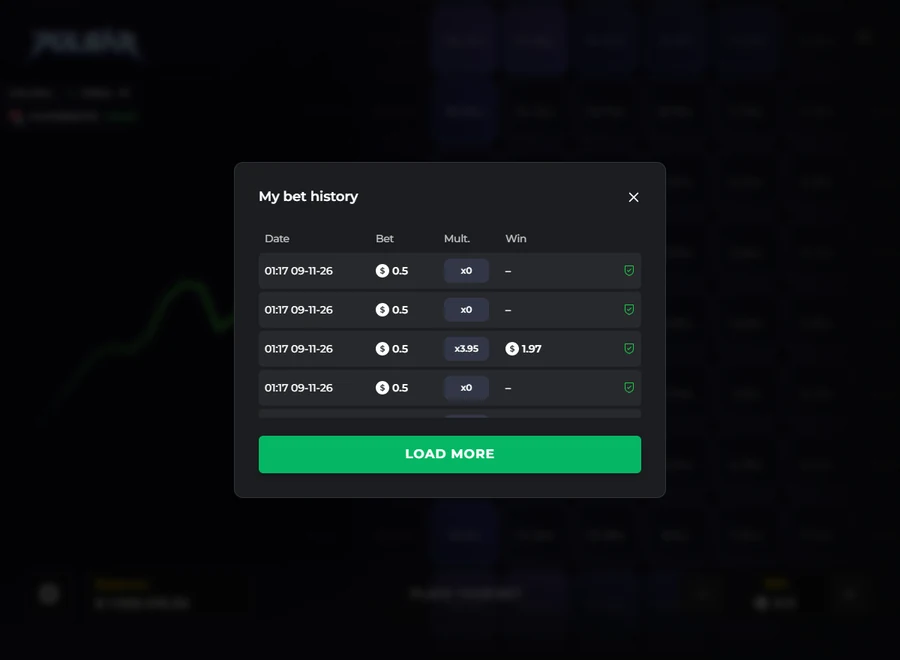
After that we grouped the bets by distance from the line. The history panel logs each one as bet, multiplier and win, so the totals below come from the game’s own records rather than from the balance, which another InOut demo was moving at the same time.
| Where | Bets | Hits | Staked | Returned |
|---|---|---|---|---|
| On the line’s row, first to fifth open column | 8 | 2.21x, 1.66x, 2.17x, 2.81x | $4.00 | $4.41 |
| One row above or below | 4 | 2.57x | $2.00 | $1.28 |
| Two or three rows away | 6 | 8.72x, 3.95x | $3.00 | $6.33 |
| All bets | 18 | 7 hits | $9.00 | $12.02 |
Half the bets on the line’s own row came in, and four hits at 1.66x to 2.81x returned 41 cents more than the eight bets cost. The cells one row off were the worst group, one hit from four. Payouts are cut to the cent, never rounded up: 50 cents at 2.57x is $1.285 and the history shows 1.28; 2.81x paid 1.40 rather than 1.41; 3.95x paid 1.97 rather than 1.98.
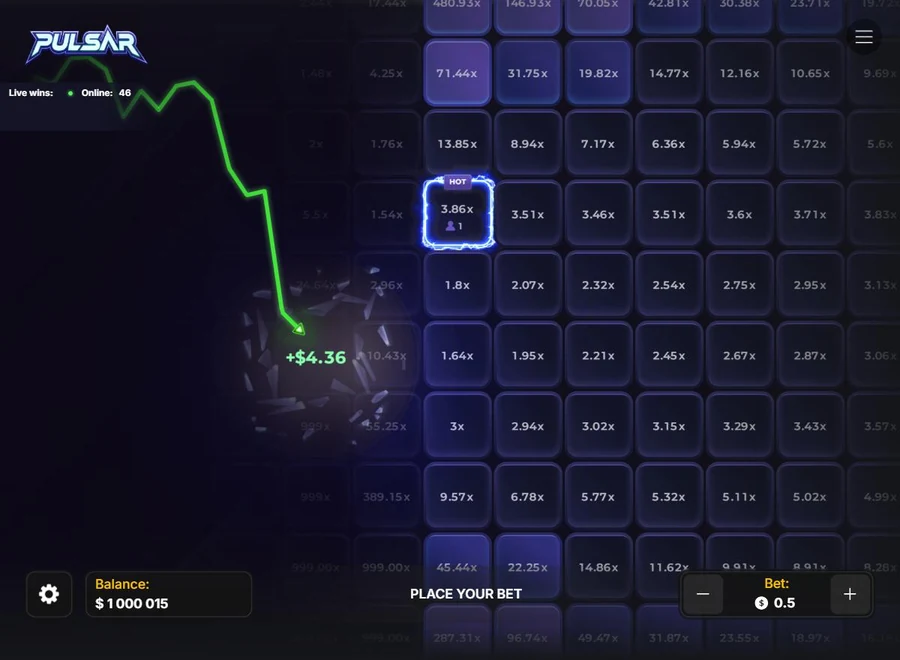
The best moment came from a cell two rows under the line in the middle of the open area, priced at 8.72x. The line ran flat for a second and then dropped almost straight down through both rows; the cell burst into glass shards and +$4.36 floated over the tip of the line. Of our six bets two or three rows away, that one and a 3.95x cell paid, and together they returned $6.33 on $3.
One click in that last group never became a bet: we clicked six cells and the history lists five. The rules describe an ERROR state for this, a cell that closed for betting before the bet reached the server, with no money taken. We did not catch the label on screen, and the balance confirms nothing was charged for it.
HOT cells and a crowd you cannot see
InOut’s page calls Pulsar a single-player game, but the board belongs to everyone on the server. An Online counter in the corner read 25 when we started and 46 to 48 later, and a Live wins ticker scrolled other people’s results; our own wins appeared there under the random name the demo gave us. Some cells carry a HOT tag and a small person icon with a count, the number of players who have bet on them. We saw it on a 1.89x cell and a 3.86x cell, one player each. The rules say HOT changes neither the coefficient nor the result nor the payout.
94%, a $200 bet and a 999x cell
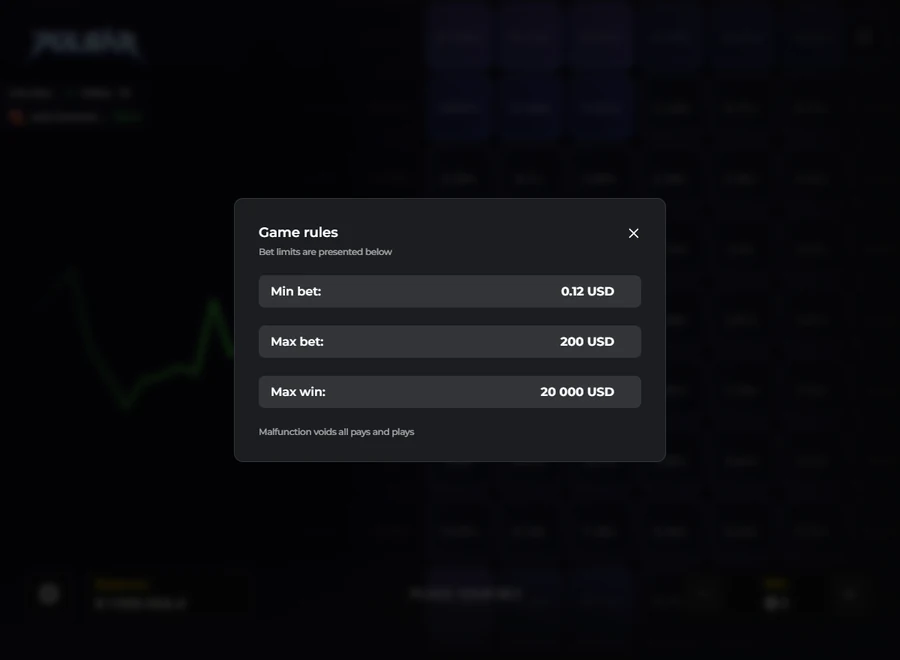
The 94% on the official page puts Pulsar at the bottom of the InOut range we cover, level with Squid Gamebler and a point under Avia Wheel, which came out the same day. The Game rules panel sets bets from $0.12 to $200 and caps a win at $20,000. That cap is only 100 maximum bets, so a 999x cell pays in full only up to a $20 stake.
| Provider | InOut Games |
|---|---|
| Game type | Bet on grid cells a moving line must cross |
| RTP | 94% (official page) |
| Coefficients | Under 2x beside the line; 999x seen in the far corners |
| Win condition | The line crosses your cell before its column completes |
| Cash-out | None; the coefficient locks when the bet is accepted |
| Bet limits | $0.12 to $200; max win $20,000 (demo rules panel) |
| Our session | 18 bets at $0.50, 7 hits, $12.02 back on $9.00 |
| Fairness | Provably fair settings in the menu; shield icon on each history row |
| Platforms | HTML5 in the browser |
| Released | 27 October 2026 |
Volatility is not rated, and in Pulsar it is a setting you choose with each tap: the line’s row behaves like a coin flip at about 2x, the corners like a lottery ticket. The menu holds Provably fair settings, and each row of the bet history has a green shield for checking that bet; we did not run a verification ourselves.
Pulsar predictors and APKs
Pulsar runs in the browser straight from InOut’s servers, with nothing to install. A Pulsar APK or a “Pulsar predictor” in search results did not come from the studio: the line’s next strokes are decided on the server, and a coefficient is only known when the cell appears on the grid.
- Instant play in any mobile browser
- Works on Android, iOS and desktop
- No install and no phone storage used
- Always the latest, up-to-date version
Where to put the chip
Pulsar is a clever idea that takes ten seconds to learn, and the pricing table is the interesting part: it rewards watching where the line has been before choosing where it will go. Against it stand an RTP that ties for the lowest we have recorded for InOut and a pace that turns bets into a reflex. Our eighteen came out $3.02 ahead thanks to two long shots, which says more about variance than about skill. If you want the same studio on the same day with a decision you can act on mid-round, the crash bonus of Avia Wheel gives you a button to press.

Pulsar questions
How do you play Pulsar?
Can you cash out a Pulsar bet early?
Why do some cells pay more than others?
What did 18 bets return?
What is the RTP of Pulsar?
What does HOT mean on a cell?
Is there a Pulsar app or predictor?