Does anything you do after pressing Play change where a Bounce Ball ball lands? No: the rules say the result of each ball is decided before its flight, so the only choices are the bet, one of three difficulty levels and whether to pay for a Buy Bonus mode. Bounce Ball, which InOut Games put out on 10 November 2026, is an instant-win ball game with a 96% RTP on its official page. A ball rattles around a spinning ring, every bounce off the ring raises its multiplier, and it then falls through a gap onto a strip split into WIN and LOSE. The demo is free and opens without registration, and across it we logged 62 balls: $111.00 staked, $77.10 returned.
 United States
Bounce Ball available at Cafe Casino
Free browser play - no download, no registration, no deposit
Same game, real wins
Cafe Casino runs the same Bounce Ball with the same odds and adds a welcome bonus for players from the United States:
300% up to $2,000 + 150 FS 18+ · T&Cs apply · the demo stays free
How does Bounce Ball work?
Bounce Ball works in three steps that the intro cards print as Place your bet, Bounce & Build, Win or Lose. Pressing Play takes the stake and launches one ball into the middle of a white ring that rotates slowly and has a single gap. Each time the ball hits the ring, from the inside or from the outside, its multiplier goes up by a fixed step, and the number above the ball shows its current value: the bet times that multiplier. Bounces off the two dashed side walls change nothing.
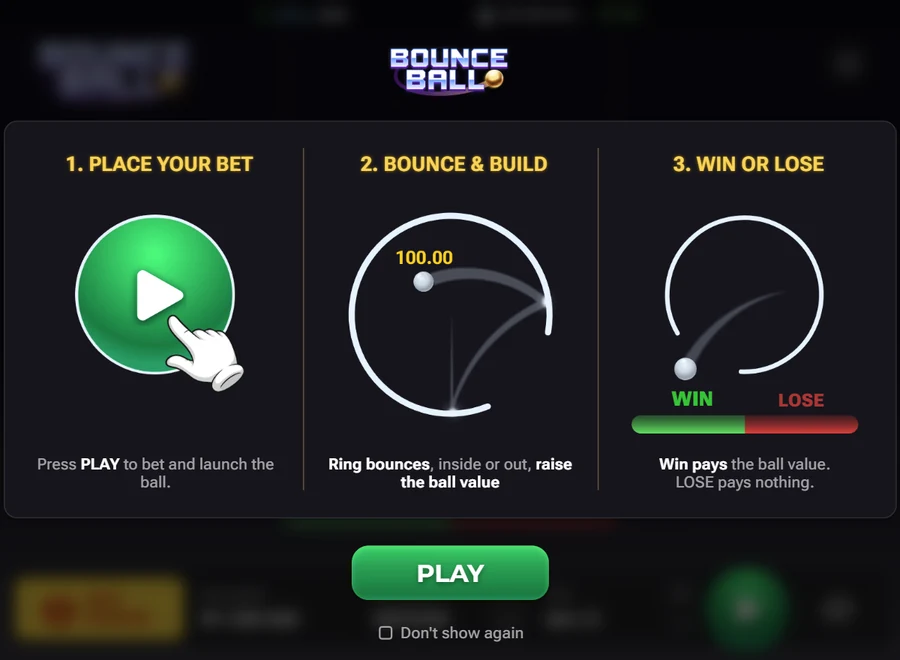
A round ends when the ball escapes through the gap and drops onto the strip at the bottom of the screen. If it comes down on the green WIN part, the ball pays its value; on the red LOSE part it pays nothing, however much it had built. Nothing can be cashed out on the way and no second decision is offered; one ball takes between three and eleven seconds. The start screen holds the whole interface: Buy Bonus, balance, difficulty, bet, a round green Play button and an autoplay button beside it.
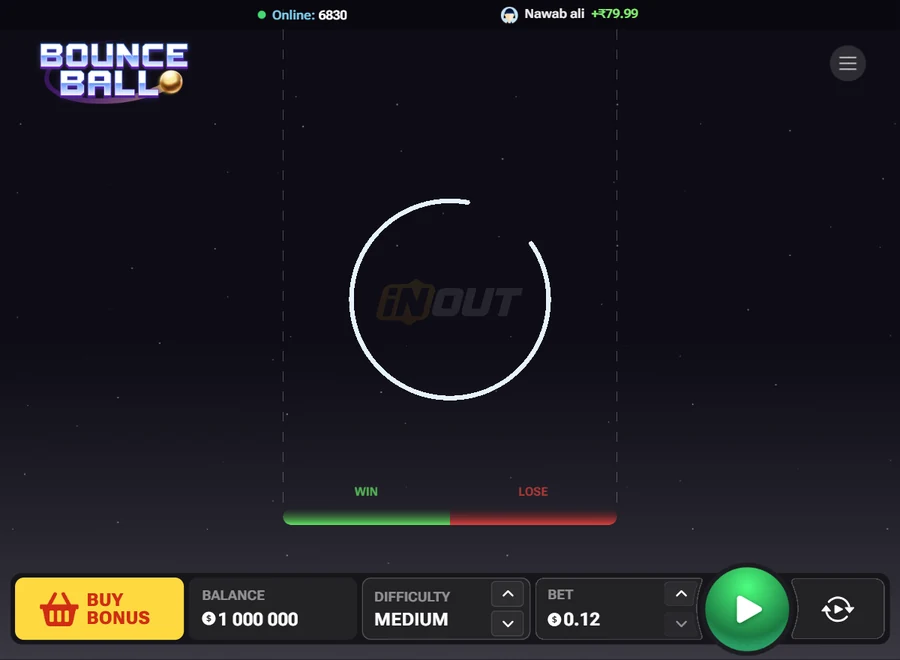
Two details of the controls matter in practice. The Play button stays live while a ball is in the air, so several balls can be flying at once, each charged and settled separately; in one stretch we had six of them launched within about six seconds. A menu switch lets the space bar launch a ball, and autoplay can be set anywhere from 10 rounds to 1,000 or left without a limit.
Easy, Medium and High, bounce by bounce
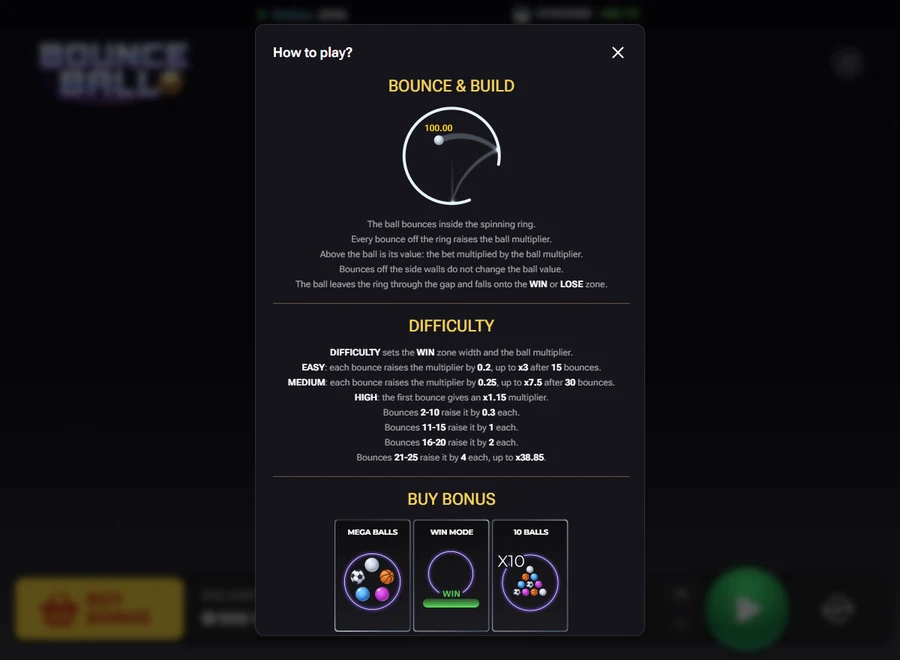
Difficulty in Bounce Ball sets two things at once: how wide the WIN zone is and how fast the ball gains value. The WIN zone takes 70% of the strip on Easy, 50% on Medium and 30% on High, and the How to play text adds that the zone width matches the chance to win. On Easy every ring bounce adds 0.2 to the multiplier up to x3 after 15 bounces. On Medium every bounce adds 0.25 up to x7.5 after 30 bounces. High starts at x1.15 on the first bounce, adds 0.3 for bounces 2 to 10, then 1 for bounces 11 to 15, 2 for bounces 16 to 20 and 4 for bounces 21 to 25, which is where the top ball of x38.85 comes from.
| Ring bounces | Easy (WIN 70%) | Medium (WIN 50%) | High (WIN 30%) |
|---|---|---|---|
| 1 | x0.20 | x0.25 | x1.15 |
| 4 | x0.80 | x1.00 | x2.05 |
| 5 | x1.00 | x1.25 | x2.35 |
| 10 | x2.00 | x2.50 | x3.85 |
| 15 | x3.00 (cap) | x3.75 | x8.85 |
| 20 | no further rise | x5.00 | x18.85 |
| 25 | no further rise | x6.25 | x38.85 (cap) |
| 30 | no further rise | x7.50 (cap) | no further rise |
The table shows why a ball on the WIN zone is not always a profit. An Easy ball needs five ring bounces to be worth the stake and six to beat it, a Medium ball needs four and five, while on High the very first bounce already puts the ball at x1.15. A ball that slips through the gap early on Easy or Medium can land on green and still hand back 60 or 75 cents of a dollar.
What 39 one-dollar balls did
Our base-game sample was 39 balls at $1 each: 12 on Easy, 15 on Medium and 12 on High, after one warm-up ball at $0.42 that built to $1.05 over ten bounces and then fell on LOSE. The 39 balls cost $39.00 and returned $30.60. Every figure below comes from the game’s own bet history, because other InOut demos were moving the shared demo balance at the same time.
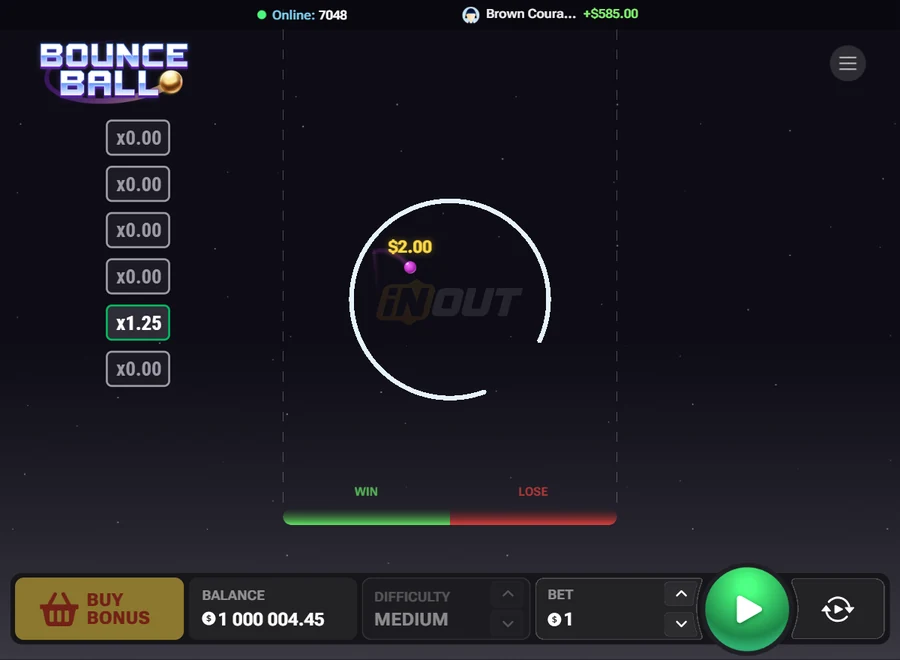
The split by outcome, level by level, looked like this.
| Outcome of a $1 ball | Easy (12) | Medium (15) | High (12) | All 39 |
|---|---|---|---|---|
| Landed on LOSE, paid nothing | 1 | 10 | 10 | 21 |
| Landed on WIN, paid under $1 | 3 | 1 | 0 | 4 |
| Landed on WIN, paid $1.00 to $1.99 | 4 | 2 | 0 | 6 |
| Landed on WIN, paid $2.00 to $2.99 | 4 | 1 | 2 | 7 |
| Landed on WIN, paid $4.50 | 0 | 1 | 0 | 1 |
| Returned on the balls staked | $16.20 on $12 | $10.00 on $15 | $4.40 on $12 | $30.60 on $39 |
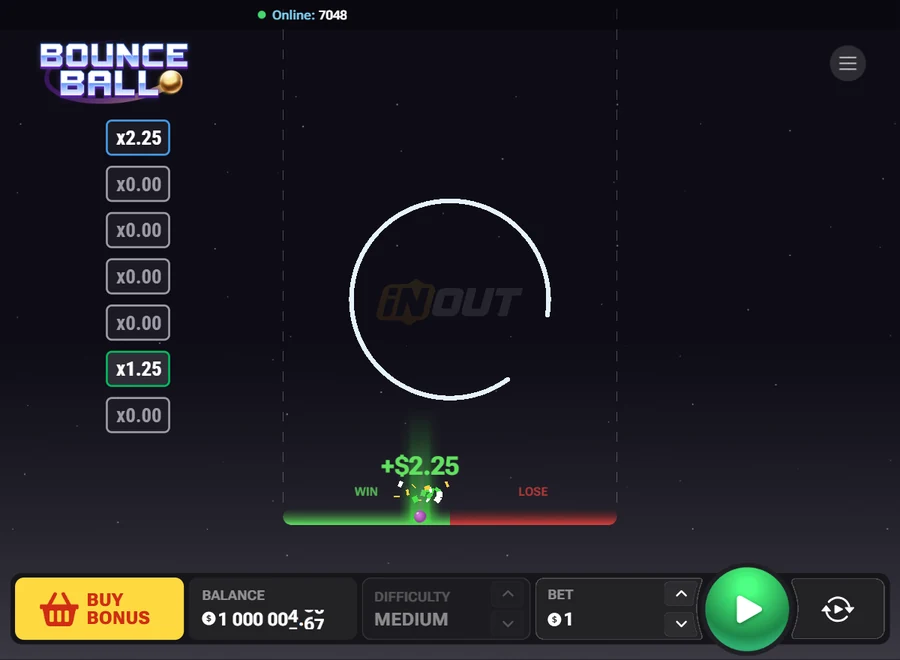
Easy was the only level that finished ahead. Eleven of its twelve balls came down on green, at x0.60, x0.60, x0.80, x1.20, x1.20, x1.40, x1.80, x2.00, x2.00, x2.20 and x2.40, so three of the eleven “wins” paid less than the dollar staked and the best one was twelve bounces long. Medium landed on WIN five times in fifteen, a third instead of the nominal half, and paid x0.75, x1.25, x1.25, x2.25 and x4.50; that last ball took 18 ring bounces and was the largest base-game payout of the session.
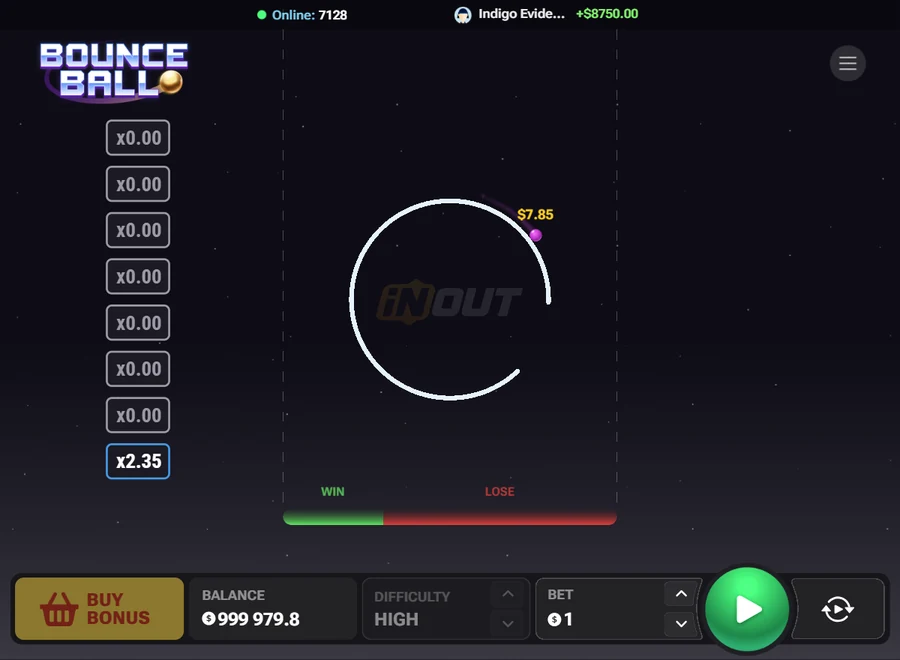
High behaved the way a 30% zone suggests. Two balls of twelve paid, x2.05 after four bounces and x2.35 after five, and ten paid nothing. The most painful of the ten was the last: it stayed in play for almost eleven seconds, passed the tenth bounce where the step grows from 0.3 to 1, reached $7.85 after fourteen bounces and then came down on the red side.
The 96% RTP, converted into bounces
InOut publishes a single RTP of 96% for Bounce Ball and no volatility rating. Because the rules also publish the chance of landing on WIN, the two numbers can be combined: return equals the chance to win times the average value of a winning ball. If the 96% holds on each level, a winning ball must average about x1.37 on Easy (0.96 divided by 0.70), x1.92 on Medium (0.96 divided by 0.50) and x3.20 on High (0.96 divided by 0.30). In bounces that is roughly seven on Easy, between seven and eight on Medium and eight on High.
Our winners were close to those targets on two levels. The eleven Easy wins averaged x1.47 and the five Medium wins averaged x2.00, while the two High wins averaged x2.20, a full point below what the arithmetic expects. A sample of 39 balls proves nothing about the RTP; the comparison is here to show the scale of a normal result. InOut does not publish how the number of bounces is distributed, and the demo gives no way to read it.
Four Buy Bonus modes and what each one cost us
Buy Bonus in Bounce Ball does not buy a feature round. It switches on one of four modes that change every following spin until the mode is turned off with the lever that replaces the Buy Bonus button; only one mode can be active at a time. The price is a multiple of the current bet and three of the four prices depend on difficulty.
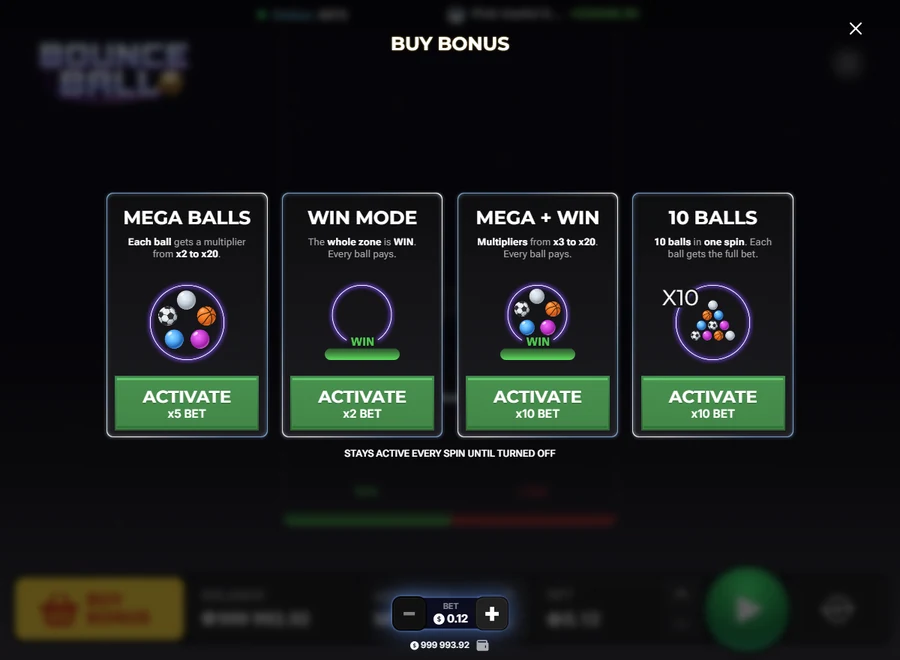
The rules list the prices as follows.
| Mode | Easy | Medium | High | What it changes |
|---|---|---|---|---|
| MEGA BALLS | x5 | x5 | x5 | Extra multiplier on every ball: x3 to x20 on Easy, x2 to x20 on Medium and High |
| WIN MODE | x1.5 | x2 | x4 | The whole strip is WIN, so every ball pays its value |
| MEGA + WIN | x7.5 | x10 | x20 | Both at once: x4 to x10 on Easy, x3 to x20 on Medium and High |
| 10 BALLS | x10 | x10 | x10 | Ten balls in one spin, each with the full bet and its own result |
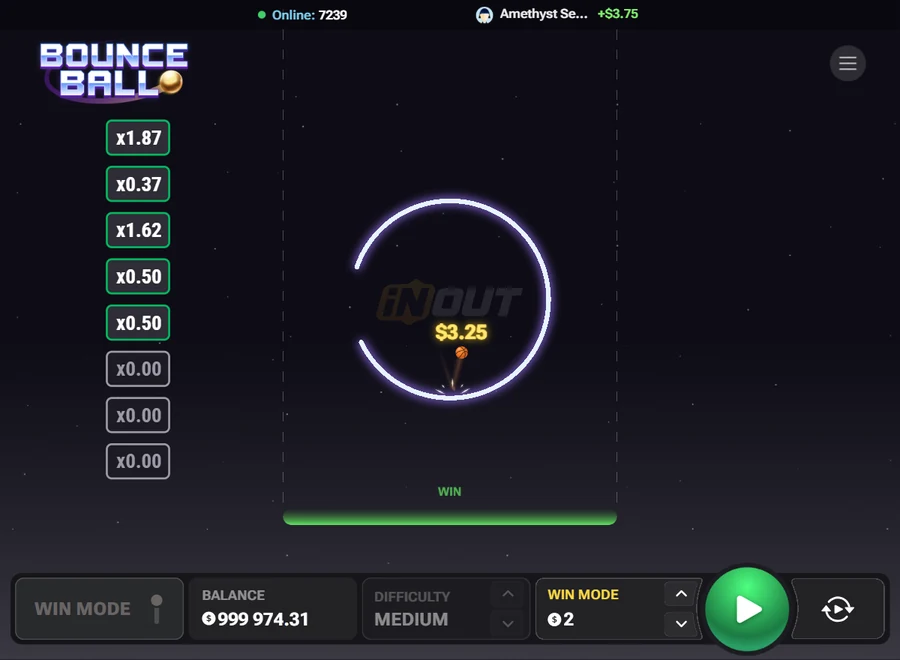
WIN MODE is the easiest to judge. On Medium it costs x2, which is the inverse of the 50% win chance, so it is the same bet at double size with the landing removed. On Easy the price of x1.5 is above 1 divided by 0.70 (x1.43), and on High x4 is above 1 divided by 0.30 (x3.33); unless balls bounce longer in WIN MODE, which the rules do not say, those two levels charge more than the base game for the same ball. We bought six Medium balls in WIN MODE for $2 apiece; the payouts were 75 cents, a dollar twice, then $3.25, $3.75 and $4.50. That is $14.25 for $12.00 spent, and half of the six returned under their price.
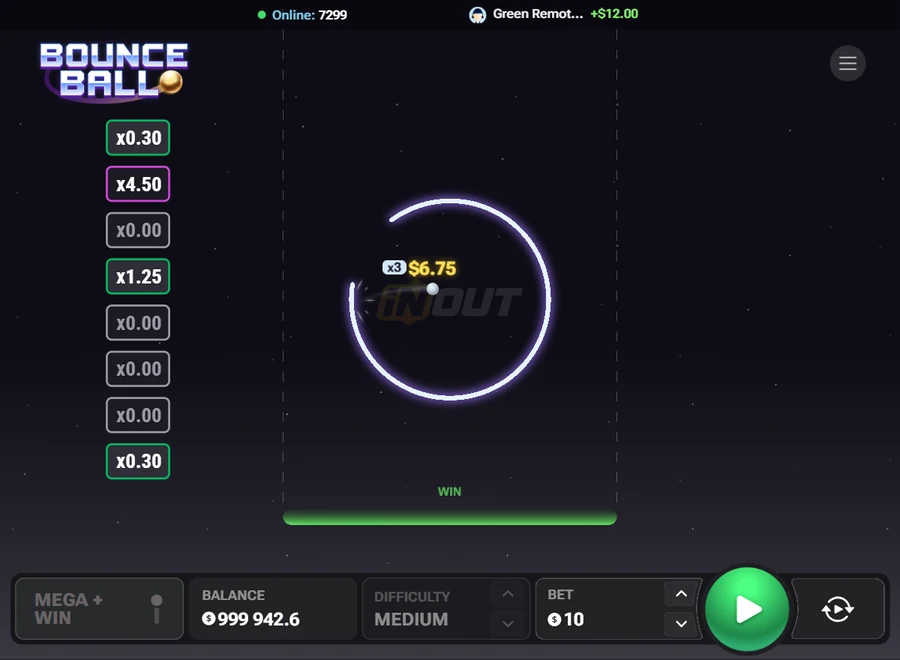
MEGA BALLS went the other way. Four Medium balls at $5 each still needed the 50% landing; three fell on LOSE and the fourth paid $1.50, so $20.00 became $1.50. MEGA + WIN at $10 a ball paid every time, $3.00, $8.75 and $11.25, a total of $23.00 on $30.00. The $11.25 ball carried an x3 tag: fifteen bounces made it worth x3.75 and the tag tripled it.
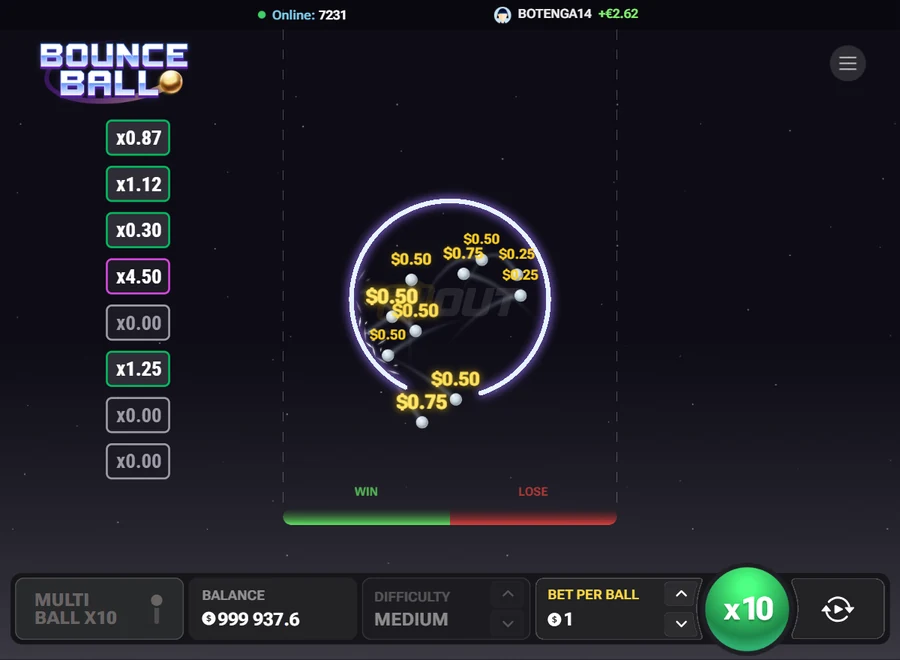
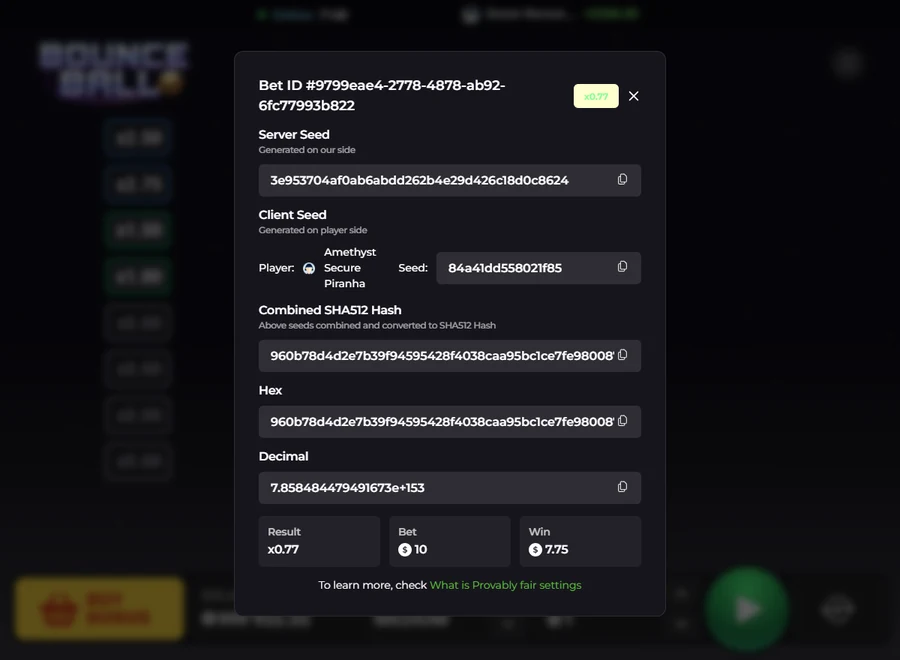
10 BALLS on Medium cost $10 for one press and filled the ring with ten white balls at $1 each. Four reached the WIN zone, at $1.00, $1.50, $2.50 and $2.75, and the spin returned $7.75. The bet history stores such a spin as a single row with a multiplier of x0.77, because the Mult. column is the win divided by the spin cost and cut to two decimals: $3.75 on a $2 WIN MODE ball is listed as x1.87, and $11.25 on $10 as x1.12.
Taken together the four modes cost us $72.00 and paid $46.50.
| Mode (Medium, $1 bet) | Bought | Balls that paid | Cost | Returned |
|---|---|---|---|---|
| WIN MODE | 6 balls at $2 | 6 of 6 | $12.00 | $14.25 |
| MEGA BALLS | 4 balls at $5 | 1 of 4 | $20.00 | $1.50 |
| MEGA + WIN | 3 balls at $10 | 3 of 3 | $30.00 | $23.00 |
| 10 BALLS | 1 spin at $10 | 4 of 10 | $10.00 | $7.75 |
| All four | 23 balls | 14 of 23 | $72.00 | $46.50 |
How much can one Bounce Ball ball win?
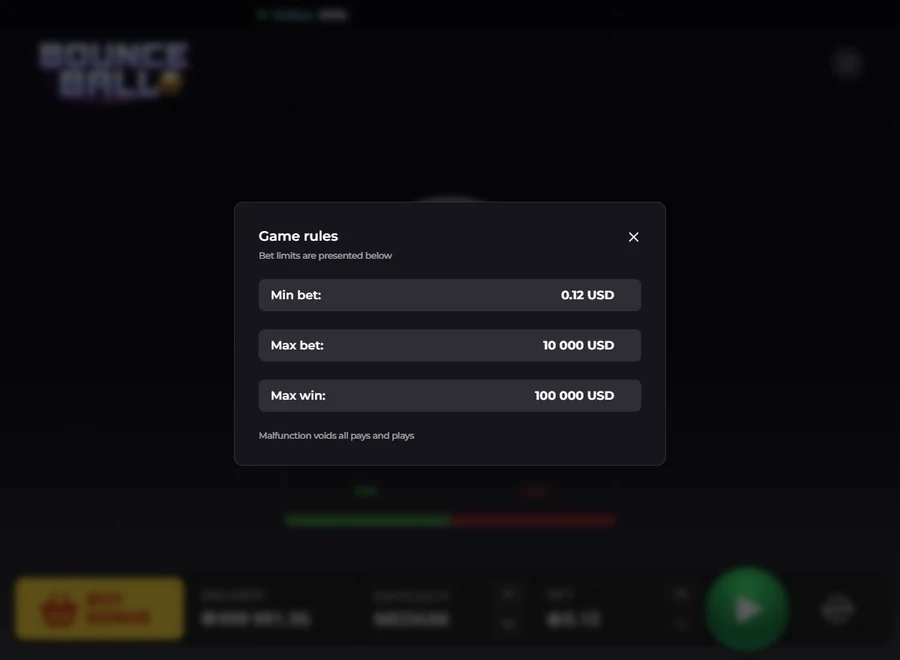
One Bounce Ball ball can win at most $100,000; the demo’s Game rules panel prints that cap together with a bet range of $0.12 to $10,000. Those limits are far wider than the $200 bet and $20,000 win printed in the InOut games released two weeks earlier; of the four titles that came out on 10 November only Grand Hustle has a higher ceiling, $200,000. The highest plain ball is x38.85, reached on High after 25 ring bounces, so the cap only starts to bite at stakes above about $2,574.
With MEGA BALLS the arithmetic changes: the rules multiply the ball value by the extra multiplier, up to x20, and x38.85 times 20 is 777 times the bet. The rules state no separate ceiling for that product, and we saw nothing near it; our largest extra multiplier was the x3 described above.
| Provider | InOut Games |
|---|---|
| Game type | Instant-win ball game: ring bounces build a value, a WIN or LOSE strip settles it |
| RTP | 96% (official page) |
| Difficulty | Easy 70% WIN, up to x3; Medium 50%, up to x7.5; High 30%, up to x38.85 |
| Cash-out | None; the result of each ball is decided before its flight |
| Buy Bonus | MEGA BALLS x5, WIN MODE x1.5 to x4, MEGA + WIN x7.5 to x20, 10 BALLS x10 |
| Bet limits | $0.12 to $10,000; max win $100,000 (demo rules panel) |
| Volatility | Not published |
| Our session | 62 balls, $111.00 staked, $77.10 returned; best base ball x4.50 |
| Fairness | Provably fair settings; seeds and hash on every history row |
| Platforms | HTML5 in the browser |
| Released | 10 November 2026 |
Bounce Ball next to three other InOut games
Bounce Ball belongs to a small group of InOut titles where the round plays itself once the stake is down. The closest relative by look is Plinko Aztec, another ball game with a published 98% RTP, where the player chooses how many balls to drop instead of a difficulty level. The table lines the four up using the figures from our own reviews.
| Game | RTP | What the player decides | Ceiling | Released |
|---|---|---|---|---|
| Bounce Ball | 96% | Bet, difficulty, optional bonus mode; nothing during the flight | x38.85 ball on High; $100,000 in the demo rules | 10 November 2026 |
| Plinko Aztec | 98% | Number of balls and when to spin the wheel | 1,000x, capped near €20,000 | January 2025 |
| Drop The Billionaire | 96% | Bet and paid modes; the fall plays itself | Landing zones x4 to x20 | 9 June 2026 |
| Pulsar | 94% | Which cell to back; no cash-out | 999x cell; $20,000 | 27 October 2026 |
What sets Bounce Ball apart inside that group is how much of its maths is printed. The win chance of each level and every step of each ladder are in the rules, where Pulsar leaves the pricing of its cells unexplained and pays two points less in RTP. The price of that openness is a modest top end on the two gentler levels: x3 on Easy and x7.5 on Medium.
The paid modes have a precedent too. Drop The Billionaire sells a Chance Bet at x1.5 of the stake, and in the same way the extra money in Bounce Ball buys a different shape of the same round, not a separate feature. The difference is that a Bounce Ball mode stays switched on until the player turns it off, so the cost repeats with every press.
Is Bounce Ball fair, and can a predictor or an APK help?
Bounce Ball uses the provably fair scheme found across the InOut catalogue, and no predictor can work against it. Provably fair settings show the client seed and a hash of the next server seed before a ball is launched. After the round, the shield on a history row opens a card with the Bet ID, the server seed, the client seed, a combined SHA512 hash, its decimal form and the result. The studio does not publish how the seeds are combined or how the hash becomes a bounce count, so we could not recompute a ball ourselves; the same limit is described in our Rabbit Road seed check.
Since the landing is fixed on the server before the ball moves, a “Bounce Ball predictor” or a hacked Bounce Ball APK has nothing to read from the screen: watching the gap of the ring tells you where it is, not when the ball will find it. InOut ships no installable app for this game. On a phone the ring, the strip and the bet panel fit a portrait browser window, and that page is the whole product.
Who Bounce Ball suits, and who should skip it
Bounce Ball suits players who want short rounds with the odds in plain sight. Easy at $1 a ball is the calm way to see the game: most balls come back with something, the swings are small, and our twelve returned $16.20. It also suits anyone curious about how a 96% return is put together, because the win chance and the ladder are both printed and can be checked against the history.
It is a poor fit for players who want to act during the round, since there is no cash-out and nothing to steer, and for anyone chasing a large multiple without paying for it: outside High and the MEGA modes the ball tops out at x7.5. The bonus modes need care because they stay on. Our 23 bought balls returned $46.50 on $72.00, and the four MEGA BALLS alone accounted for $18.50 of that loss. We rate Bounce Ball 4.2 out of 5: clear rules, quick rounds, and a bonus menu that costs more than it looks.
Bounce Ball questions
What kind of game is Bounce Ball?
Which difficulty pays the most in Bounce Ball?
Can a ball land on WIN and still lose money?
What are the bet limits and the top prize in Bounce Ball?
How much do the Buy Bonus modes cost?
Can you cash out a ball early?
Is Bounce Ball free to try, and is there an app?