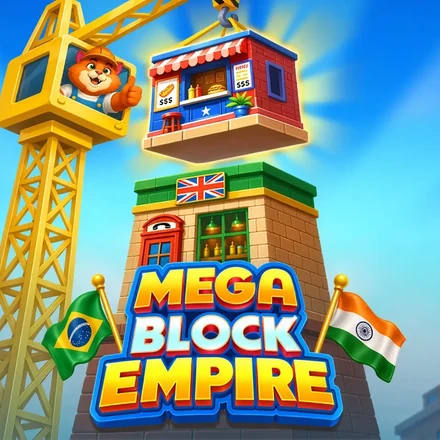
Seven months after MegaBlock, InOut Games has sent its tower-stacker on a world tour. MegaBlock Empire keeps the crane, the four difficulty levels and the 95.5% RTP of the original, swaps the plain floors for a Parisian boulangerie, a Mexican cantina, a London phone box and a Hindu temple, and bolts on the two things the first game lacked: a bonus round you can trigger by collecting Golden Helmets, and a Buy Bonus menu with four cards. It was released on 8 September 2026. We built a few cheap towers on Easy, then paid $8,000 for the most expensive card and filmed all three of its free builds.
 United States
MegaBlock Empire available at Cafe Casino
United States
MegaBlock Empire available at Cafe Casino
Free browser play - no download, no registration, no deposit
Same game, real wins
Cafe Casino runs the same MegaBlock Empire with the same odds and adds a welcome bonus for players from the United States:
300% up to $2,000 + 150 FS 18+ · T&Cs apply · the demo stays freeWhat the sequel keeps and what it drops
A sequel review should start with the diff, so here it is. Everything in the left column comes from our own MegaBlock page; everything on the right from the Empire screens and rulebook in front of us. It is the studio’s second stacking release in a month after Tower Dash, and unlike that one it is unmistakably built on the earlier game’s bones.
| Feature | MegaBlock (2026) | MegaBlock Empire |
|---|---|---|
| Released | February 2026 | 8 September 2026 |
| RTP | 95.5% | 95.5% |
| Tower heights | Easy 24, Medium 22, Hard 20, Hardcore 15 | Identical |
| Easy ladder opens | 1.01 - 1.04 - 1.09 | 1.01 - 1.02 - 1.05 - 1.09 - 1.13 |
| Special floors | Frozen, Temple, Triple Build | None in the rules we read or the rounds we played |
| Bonus game | None | Three Golden Helmets start the Free Builds |
| Buy Bonus | None | Four cards, each 100x the bet |
| Biggest printed multiplier | 2,941,884x (cash cap €20,000) | 1,000,000x on the Very Hard card |
| Blocks | Generic floors | Shops and houses from different countries |
The shared skeleton is not a guess. The Empire How to play screen still reads “MegaBlock has 4 difficulty modes” - the studio did not even rename the game in its own rulebook - and lists the same 24, 22, 20 and 15 blocks, taller than the 30-to-18 step range of the road games such as Rabbit Road only on Easy. What has changed underneath is the ladder: Empire’s Easy rungs read 1.01, 1.02, 1.05, 1.09, 1.13, 1.18, 1.23, 1.28 and, further up, 1.40, 1.48, 1.55, 1.64, 1.74, a flatter opening than the original’s 1.01, 1.04, 1.09. Nothing in the rules explains the retune, and we did not find the Frozen, Temple or Triple Build floors anywhere in the seven rules we could read or in any round we played.
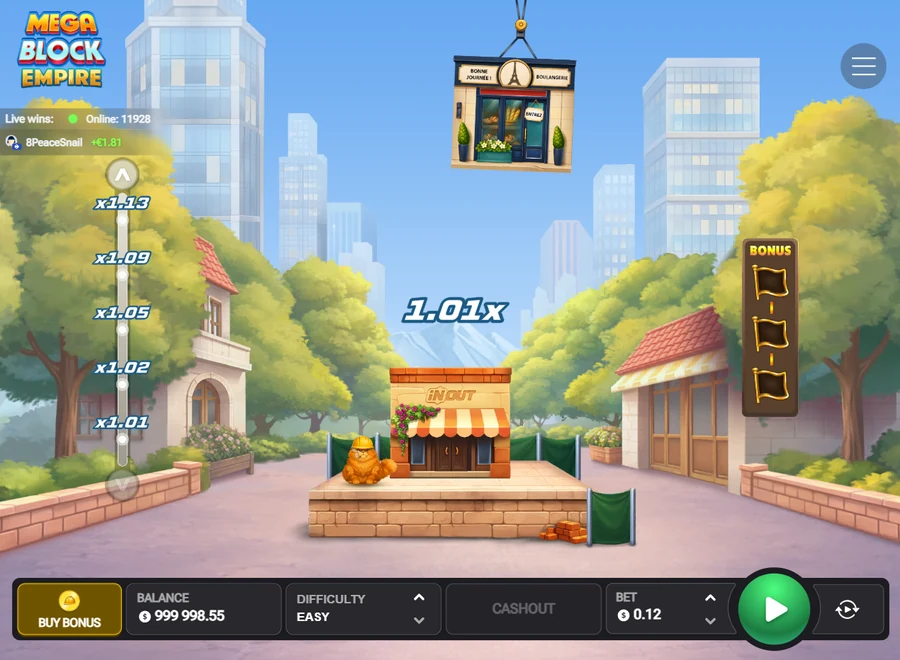
Around the world, one floor at a time
The base of every tower is an InOut corner shop with an orange cat in a hard hat sitting on the step - he is the site foreman, and he turns up again with a trowel on the win screens. Above it the crane delivers a different country each time: a French bakery with an Eiffel Tower sign, a Mexican shopfront strung with papel picado, a Brazilian house with a parrot and a football, a British building with a red phone box, a Ganesh temple with bells, a Korean bank, an American hot-dog stand. The flags in the BONUS meter on the right are the same nations, and a lit flag is a collected helmet. Two smaller touches are new for the studio: a Live wins ticker in the top-left corner showing other players’ cash-outs (we watched wins in euros and rupees scroll past with about 11,900 people online) and an auto-play button next to Play.
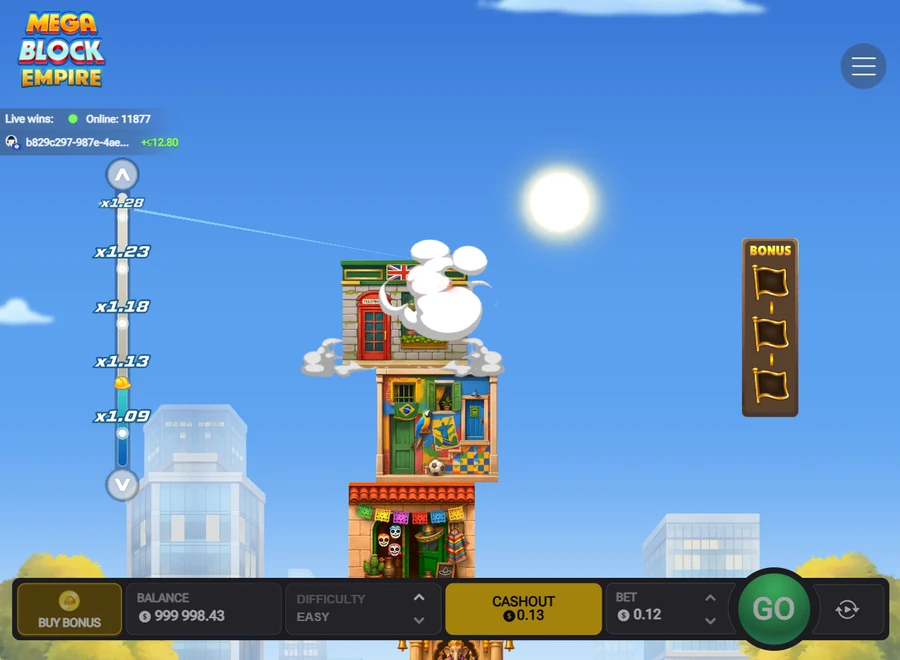
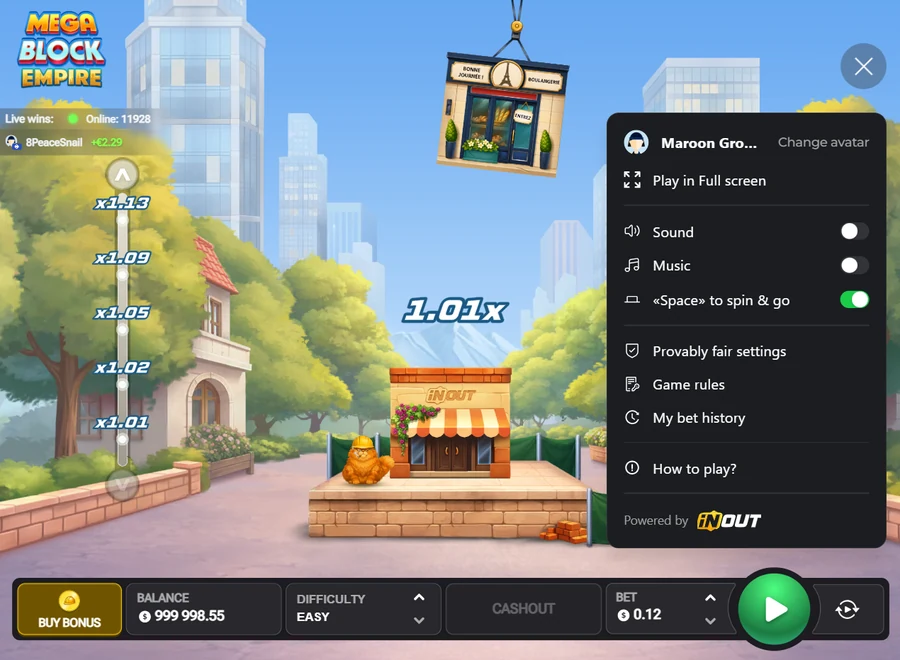
One display habit is worth learning early. The big multiplier in the middle of the screen is the rung the block on the hook will earn if it lands - it reads 1.01x before a single floor is placed - not the multiplier you currently hold. The CASHOUT button is the truth: it shows the bet times the last rung you actually reached. Once you know that, the tower tells the story clearly, with the passed rungs turning blue on the rail and a small golden helmet marking the rung where a helmet is waiting.
A $0.12 tower on Easy, and a helmet at 1.48x
The demo opens at a 12-cent bet, which we kept because it makes the arithmetic easy to check against the screen. Three floors up on Easy - Mexico, Brazil, then the phone box landing in a puff of dust - the rail had passed 1.09x and the CASHOUT button read $0.13, which is 0.12 x 1.09 = 0.1308 with the fraction dropped. A helmet icon was sitting on the 1.13x rung above, waiting for the next clean landing.
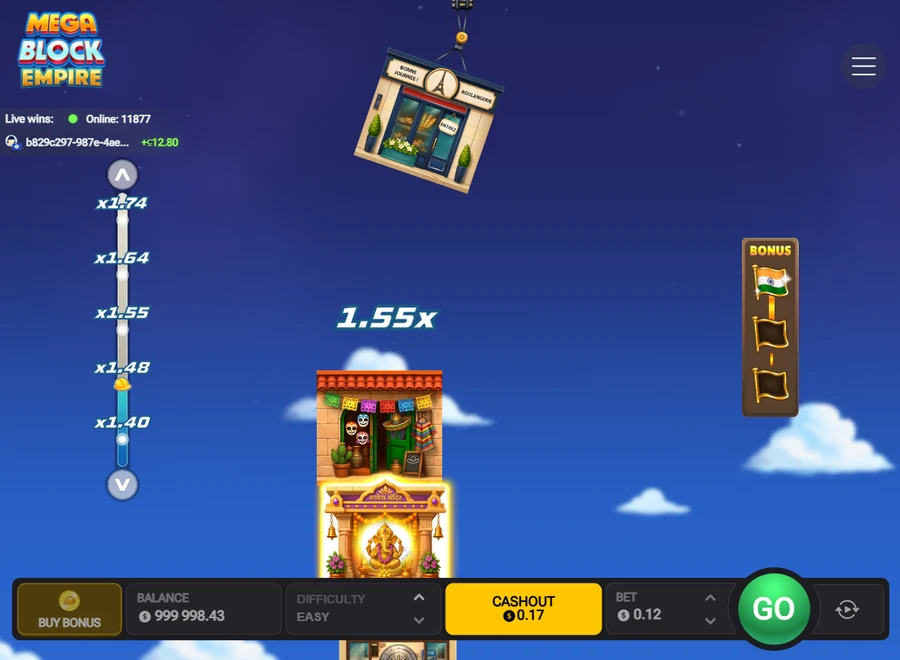
By the time the sky had turned to night the tower had reached 1.48x with the temple glowing on top, the first flag had lit in the BONUS meter and the button read $0.17 - 0.12 x 1.48 = 0.1776, truncated to the cent. The 1.55x in the middle of the screen was the rung the bakery on the hook would have earned; we took the $0.17 instead, and the balance moved from $999,998.43 to $999,998.60, which is the whole win and not a cent more. One helmet out of the three the bonus needs, banked for nothing but a pleasant screenshot.
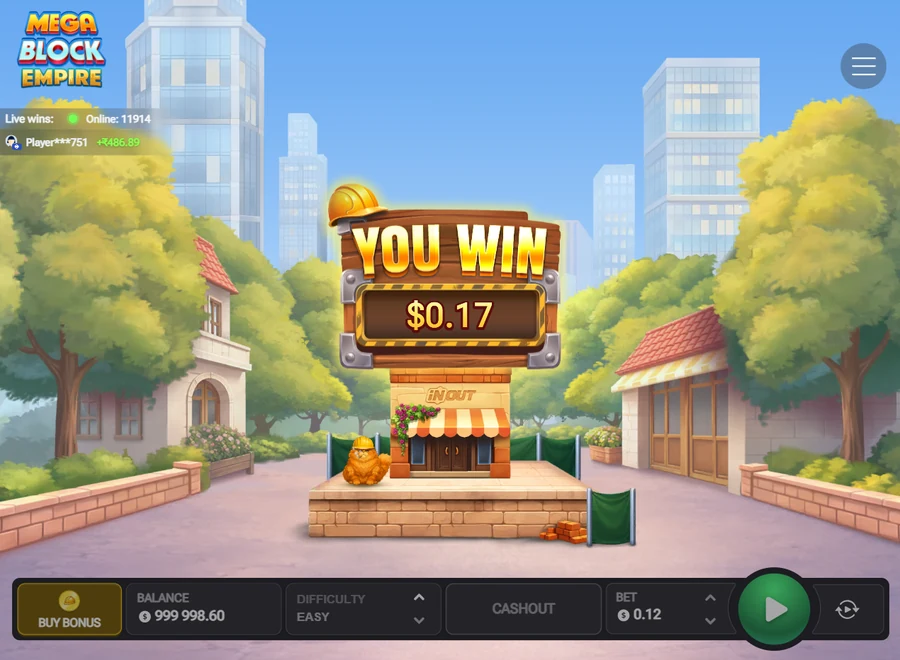
Golden Helmets, flags and the free builds
Rule 7 is the one that makes this a different game from its parent. Golden Helmets “may randomly appear each time you successfully place a block”; collect three and the Bonus Game starts on its own. The rulebook describes that bonus as a fixed number of Free Builds in which blocks are placed automatically, and every multiplier those builds earn is accumulated and added to your total win. The helmet count does not seem to carry across rounds - our lit flag was gone the next time we pressed Play - so the free trigger is something you earn inside one tall tower, which on Easy means a long climb.
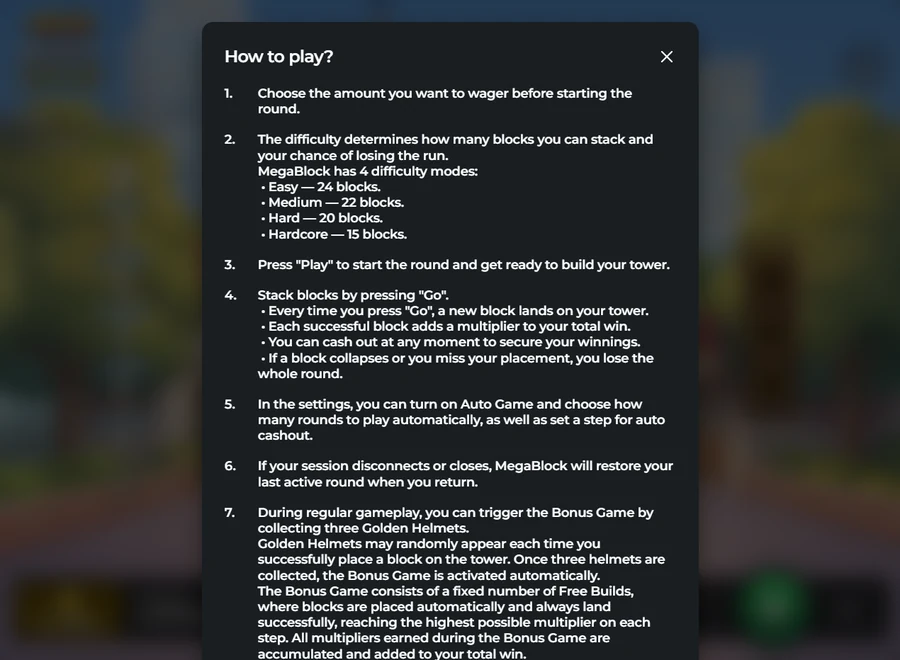
The other four rules are housekeeping, and two of them are genuinely useful: rule 5 says Auto Game can be set for a number of rounds with a step for automatic cash-out, and rule 6 promises that a dropped connection restores your last active round when you return. The rulebook closes, as every InOut rulebook does, before it tells you the cash cap or the bet limits.
Buy Bonus: four cards, one price, four ceilings
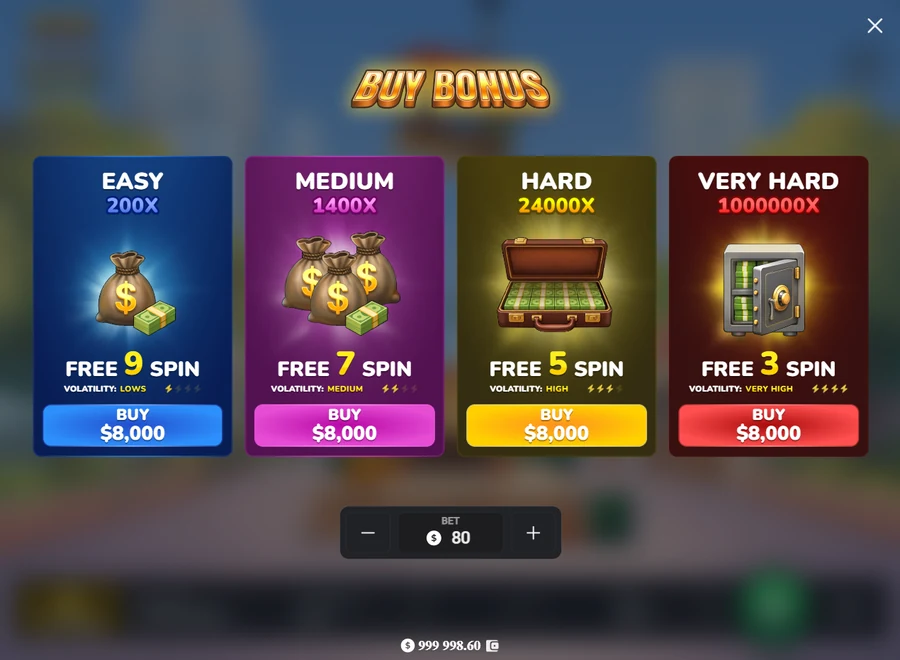
The gold BUY BONUS button opens four cards over a bet stepper, and the price does not vary between them: with the stepper at $80 every card cost $8,000, which is 100x the bet across the board. What varies is what you are buying - the difficulty the free builds run on, how many of them you get, and how high the card’s printed ceiling goes. It is the same design as the four identical-price cards in Chicken Road 2 Bonus, and the same trade-off: fewer builds for a bigger number.
| Card | Printed max | Free builds | Volatility |
|---|---|---|---|
| Easy | 200x | 9 | Low |
| Medium | 1,400x | 7 | Medium |
| Hard | 24,000x | 5 | High |
| Very Hard | 1,000,000x | 3 | Very high |
The cards label the free builds “free spins” and rate their volatility with one to four lightning bolts, and those four maximums - 200x, 1,400x, 24,000x and 1,000,000x - are the only ceilings printed anywhere in the game. The Very Hard card is the one with the safe on it, three builds on Hardcore, and it is the one we bought.
MegaBlock Empire bonus video: the Very Hard card for $8,000
Half a minute covers the whole purchase. The bet stepper goes to $80, the red card takes $8,000 off a $999,998.60 balance, a safe swings open on YOU WON 3 FREE GAMES, and a brick-wall loading screen with a “Build, Build, Profit!” note leads into a sunset version of the site. Watch the FREE GAMES LEFT counter under the tower, the difficulty box reading HARDCORE, and the TOTAL WIN plaque that counts up after each build.
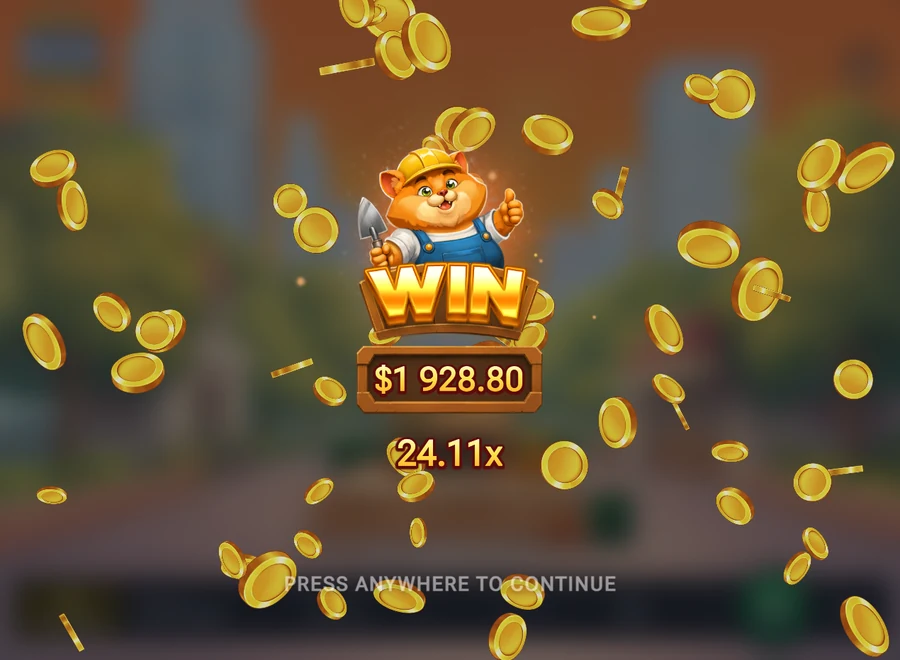
The plaque tells the arithmetic in three steps. The first build stopped at 5.47x. The second ended with an American hot-dog stand toppling off the top of a French-Korean tower and lifted the running total to 20.69x, so that build was worth 15.22x on its own. The third added 3.42x, and the final plaque read $80 x 24.11 before the cat and the coins came out: $1,928.80 back on an $8,000 ticket. That is a loss of $6,071.20 - the card returned a little under a quarter of its price, and the tower that did most of the work still reached only 15x on a card whose printed ceiling is 1,000,000x. One more thing the tape settles: the rulebook says free builds “always land successfully”, yet we watched a block fall. Read that line as a fall ends the build and banks what it reached, rather than as a promise that every build climbs to the top.
RTP 95.5%, the published date, and the numbers still missing
The official page prints a 95.5% RTP and an 8 September 2026 release day, the same day the studio put out KO Million, and the rate is unchanged from the original MegaBlock. That is the bottom of InOut’s stacking range - Tower Dash runs at 96% - and it does not move between the four difficulties. What is not published: a maximum win for the base game (the card ceilings are the only figures anywhere), a cash cap of the kind the original carried at €20,000, the bet limits, and a volatility rating beyond the bolts on the cards. The demo’s $0.12 default and the $80 we set in the buy menu tell you the stepper is wide, not what its ends are.
| Provider | InOut Games |
|---|---|
| Game type | Block-stacking crash game, world tour |
| RTP | 95.5% (official page) |
| Difficulty | Easy 24, Medium 22, Hard 20, Hardcore 15 blocks |
| Bonus game | Three Golden Helmets start the Free Builds |
| Bonus Buy | Four cards, each 100x the bet - 9, 7, 5 or 3 free builds |
| Printed ceilings | 200x, 1,400x, 24,000x, 1,000,000x by card |
| Extras | Auto Game with auto cash-out step, session restore, live wins ticker |
| Fairness | Provably fair settings in the menu |
| Platforms | HTML5 - desktop, iOS, Android |
| Released | 8 September 2026 |
Menu, Auto Game and the live ticker
The menu is the studio’s standard panel - avatar, Play in Full screen, Sound and Music (both off when the demo loads), a “Space to spin & go” toggle that is on, Provably fair settings, Game rules, My bet history and How to play. Auto Game lives behind the circular-arrows button beside Play rather than in this menu, and it is the feature that pairs best with the helmets: set a cash-out step, let the game grind Easy towers, and the free trigger becomes a matter of patience rather than nerve. The live ticker cannot be switched off from here, which will please some players and irritate others.
Free demo
Everything above happened on the demo: the $1,000,000 balance, the 12-cent towers and the $8,000 card. It is the full game, buy menu included, with no account and no download, and for this title in particular the demo has a specific use - the four cards cost the same and pay from very different ceilings, so ten bought bonuses on play money will tell you which volatility you can actually stomach before a single real dollar goes on the stepper.
MegaBlock Empire APK and download
There is no MegaBlock Empire APK and nothing to install. The game is HTML5 and runs in the browser on Android, iPhone and desktop - the same crane, the same flags, the same buy menu as the demo on this page - with no package to sideload and no storage used. On a phone the control bar stacks under the tower and the auto-play button stays within thumb reach.
- Instant play in any mobile browser
- Works on Android, iOS and desktop
- No install and no phone storage used
- Always the latest, up-to-date version
Launch month is when unofficial ‘Mega Block Empire app’ downloads appear, and none of them are from InOut. The browser build is always the current one; if you want an icon, open the game and use ‘Add to Home Screen’.
MegaBlock Empire FAQ
Is MegaBlock Empire the same game as MegaBlock?
What is the RTP of MegaBlock Empire?
How does the Golden Helmet bonus work?
What do the Buy Bonus cards cost?
Was the Very Hard card worth buying?
Is there a MegaBlock Empire APK?
The verdict
MegaBlock Empire is the better MegaBlock. The country blocks give a stacking game something the genre rarely has, a reason to look at the tower, and the helmet meter gives an Easy grind a goal beyond the next rung. The buy menu is the most legible InOut has made since Royal Drop: one price, four clearly ranked risks, ceilings printed on the cards. The costs are real too. The safety net of the original’s Frozen floor is gone, the base game still has no published maximum, and our $8,000 experiment came back with under a quarter of the money, which is what a four-bolt card usually does. Build on Easy until the flags start lighting, and treat the Very Hard safe as the lottery ticket its own artwork says it is.